

Start with a clear niche. A telemedicine app for “everyone” usually ends up working for no one. Build around the basics first: video calls, scheduling, and payments. Everything else can wait. Handle compliance early. Fixing HIPAA or GDPR issues later is expensive and messy. Plan your budget and timeline realistically. MVP doesn’t mean cheap, it means focused. Pick the right approach: custom build, SaaS, or a white-label development solution depending on your goals.
Telemedicine stopped being an experiment a while ago. It’s now a working business model with real money behind it. Clinics use it to extend capacity. Independent doctors use it to build private practices without renting space. Startups use it to launch niche services that run entirely online. The barrier to entry is lower than it looks, but the details decide whether it becomes a revenue stream or just another unused app.
If you’re figuring out how to develop a telemedicine app, the goal isn’t to recreate a hospital in digital form. It’s to build a system that connects patients and providers in a way that’s fast, reliable, and easy to pay for. That’s where most projects either click or fall apart.
This guide breaks the process down into clear steps. No theory dumps. You’ll see what features matter, what it costs, how long it takes, and where people usually overspend or overcomplicate things.
Why Telemedicine Still Grows in 2026

The demand didn’t fade after the pandemic. It just changed shape. Patients now expect quick access to care without waiting rooms, and providers have realized they can handle a large part of consultations remotely. Mental health services are one of the strongest drivers here. Sessions don’t require physical exams, which makes video consultations a natural fit. Private clinics are also leaning into telemedicine to expand reach without opening new locations.
Market numbers back this up. Global telemedicine is already well past the $100 billion mark and continues to grow at a double-digit rate year over year. Some projections push it toward $250–300 billion within the next few years. That kind of growth doesn’t happen without steady demand.
Another shift is the move to hybrid care. Patients don’t choose between online and offline anymore. They expect both. A first consultation might happen online, with follow-ups in person, or the other way around. That creates space for flexible digital services built around real workflows.
From a business perspective, this is where things get interesting. You’re not just building a video app. You’re building a service layer on top of healthcare. Understanding how to develop a telemedicine app means understanding where convenience meets revenue.
Step-by-Step Roadmap to Develop a Telemedicine App
If you break it down, the process follows a clear sequence. Skipping steps usually leads to delays, rework, or unnecessary costs.
- Define your niche and use case
Decide who you’re building for and what problem you solve. A mental health app, for example, needs different workflows than a chronic care platform. This step defines everything that follows. - Set your MVP scope
Focus only on core functionality: video consultations, scheduling, payments, and basic user profiles. Avoid adding advanced features before real users interact with the product. - Design user flows and UX
Map how patients book sessions, how doctors manage availability, and how payments are processed. A clean flow reduces friction and increases completed consultations. - Build core functionality first
Develop booking logic, session handling, and user roles. Use external services for video and payments instead of building them from scratch to save time and reduce risk. - Test critical components
Check video stability, payment processing, data handling, and access control. Even small bugs at this stage can break trust and hurt retention. - Launch with a limited audience
Start with a small group of users, collect feedback, and adjust quickly. Most successful telemedicine products evolve after launch, not before it.
Start With the Business Model, Not the Code

Most projects go wrong at the same point: they start with features instead of revenue. Before thinking about tech, define who this product is actually for. A solo doctor needs a simple system to book and run consultations. A private clinic cares about workflows and staff coordination. A startup usually targets a niche, like mental health or dermatology, and builds around that use case.
Then comes monetization. You don’t need ten options. You need one that works from day one:
- pay-per-session (simple and predictable for users)
- subscription plans (monthly access, popular for ongoing care)
- B2B packages (selling access to companies for employee healthcare)
Here’s how the numbers look in practice. Let’s say a doctor handles 20 sessions a day at $40 per consultation. That’s $800 daily. Over 20 working days, you’re already at around $16,000 per month. Add a second specialist or extend hours, and the revenue scales almost linearly. This is why telemedicine businesses grow fast when the model is clear.
When people ask how to develop a telemedicine app, they often expect a technical answer. In reality, the core decision is financial. If the business model is solid, the product has direction. Without it, even a perfectly built app struggles to make money.
Core Features That Actually Matter

Feature lists tend to grow fast on paper. In reality, only a handful of elements decide whether users stay and pay. The goal isn’t to impress with functionality. It’s to remove friction between booking, consultation, and payment.
- Video consultations sit at the center of the product, but quality matters more than presence. The connection has to be stable, quick to start, and work across devices without setup headaches, otherwise users drop off before the session even begins.
- Scheduling and calendar logic is what turns interest into actual revenue. Patients should be able to see real availability, book in a few clicks, and receive confirmation instantly. Any delay or confusion here directly reduces completed sessions.
- Payments integration is where many apps quietly lose money. It needs to be seamless, support different methods, and ideally handle prepayments to reduce no-shows. If users hesitate at checkout, conversions drop fast.
- Patient profiles and history help providers deliver better care without repeating the same questions. Over time, this becomes a retention driver because patients feel the service “remembers” them.
Beyond the essentials, a few additions strengthen engagement. Messaging allows quick follow-ups without booking a full session. Reminders reduce missed appointments. Follow-up prompts bring patients back after the first visit.
When thinking about how to develop a telemedicine app, this is the layer that directly affects usage. If these pieces work smoothly, growth comes naturally.
Feature Structure by User Role
| Category | Key Features | Why It Matters |
| Patient side | registration, profile, appointment booking, video consultations, payments, notifications | defines user experience and directly impacts conversion and retention |
| Doctor side | schedule management, session handling, patient notes, consultation history, availability control | ensures providers can operate efficiently without friction |
| Admin panel | user management, payments tracking, analytics, moderation, system configuration | keeps the platform scalable and manageable as it grows |
| Advanced features | EHR/EMR integration, e-prescriptions, AI triage, insurance integration, analytics dashboards | adds long-term value and competitive advantage but not required for MVP |
Security and Compliance: What You Can’t Ignore
This is the part many founders try to “figure out later.” That approach usually backfires. Healthcare data isn’t just another dataset. It’s sensitive, regulated, and closely monitored. If you’re operating in the US, HIPAA defines how patient data must be handled. In Europe, GDPR sets strict rules for storage, access, and user consent. These aren’t optional checkboxes. They shape how your product is built from the ground up.
The risks are very real. A data leak doesn’t just mean bad press. It can lead to fines, loss of trust, and in some cases, being forced to shut down operations. Even smaller issues, like insecure video tools or weak authentication, can block partnerships with clinics or insurers. In practice, compliance is what separates a side project from a real healthcare business.
At a minimum, you need strong encryption for data in transit and at rest, clear access control so only authorized users see patient information, and secure storage that meets regional standards. Logging and audit trails also matter, especially when disputes or incidents occur.
“The Security Rule requires implementation of appropriate administrative, physical, and technical safeguards to ensure the confidentiality, integrity, and availability of electronic protected health information.”
Treat compliance as part of the product, not a legal afterthought.
Technology Choices and Development Approach
At some point, every project hits the same fork in the road: what to build, and what to plug in. There’s no universal “best stack” here. The right choice depends on how fast you want to launch and how much control you need later.
Start with platforms. Web apps are faster to deploy and easier to maintain, especially for early versions. Patients can join from a browser without installing anything, which reduces friction. Mobile apps feel more natural for frequent use and help with retention through notifications, but they increase cost and development time. A hybrid approach lets you reuse code and cover both cases, though it comes with some performance trade-offs.
Then comes the build vs integrate decision. This is where timelines can double if handled poorly. Real-time video, payments, and notifications are complex systems on their own. Rebuilding them from scratch rarely gives an advantage early on.
- build core logic that defines your product, like scheduling flows, patient-provider interaction, and pricing models, because that’s where your differentiation lives
- integrate video SDKs instead of developing streaming infrastructure, since stability and latency are already solved by specialized providers
- use existing payment gateways to handle transactions, refunds, and compliance instead of reinventing financial logic
- rely on authentication and security frameworks that already meet industry standards instead of creating custom solutions from zero
The biggest mistake here is trying to make everything “perfect” from day one. A focused system that works reliably will outperform an overloaded product that never reaches users.
Budget and Timeline: Real Numbers
Let’s get straight to it. When people ask how much does it cost to develop a telemedicine app, they usually expect a single number. That doesn’t exist. The range depends on scope, features, and how much you build from scratch. Still, you can estimate early and avoid surprises.
A focused MVP with core features typically lands somewhere between $30K and $80K. A more advanced product with full workflows, integrations, and compliance layers can easily cross $100K. The main cost drivers are real-time video, backend logic, and security requirements.
Cost breakdown
| Component | Estimated Cost | Notes |
| Video infrastructure | $5K–$20K | depends on scale |
| Backend | $10K–$40K | logic, storage |
| Frontend | $8K–$30K | apps/web |
| Compliance | $5K–$15K | legal + implementation |
Timelines follow a similar pattern. An MVP usually takes around 3 to 5 months if the scope is controlled. A full product with advanced features and integrations can take 6 to 12 months.
If you’re figuring out how to develop a telemedicine app, this is where planning matters most. Overbuilding early inflates both time and cost without improving your chances of success.
Getting Your First Users

Launching the product is one thing. Getting real people to use it is where most telemedicine projects slow down. The mistake is thinking users will show up once the app is live. In reality, early traction comes from relationships, not features.
Start with a narrow niche. A general “online doctor” app struggles to stand out. A focused offer like mental health sessions for remote workers or dermatology consultations for a specific audience gives you a clear entry point. Clinics are often the fastest way to get initial volume. They already have patients, and telemedicine becomes an extension of their existing service. Instead of chasing individuals one by one, you plug into an existing flow.
Partnerships work the same way. Fitness platforms, insurance providers, or corporate wellness programs already serve audiences that need healthcare access. If your product fits into their ecosystem, you skip months of direct user acquisition.
Here’s what usually works in practice:
- partner with 1–2 clinics or specialists first, even on a revenue-share basis, so you have real consultations happening from day one instead of waiting for organic traffic
- focus your messaging on a specific problem and audience, because broad positioning makes it harder for users to understand why they should try your service
- run small, controlled ad campaigns to test demand and pricing, rather than spending heavily upfront without knowing what converts
- collect feedback aggressively from early users and adjust flows quickly, especially around booking, payments, and session experience
The key idea is simple. Don’t build in isolation. Demand should shape the product from the first users onward.
Launch a Custom Telemedicine Service with Scrile Meet
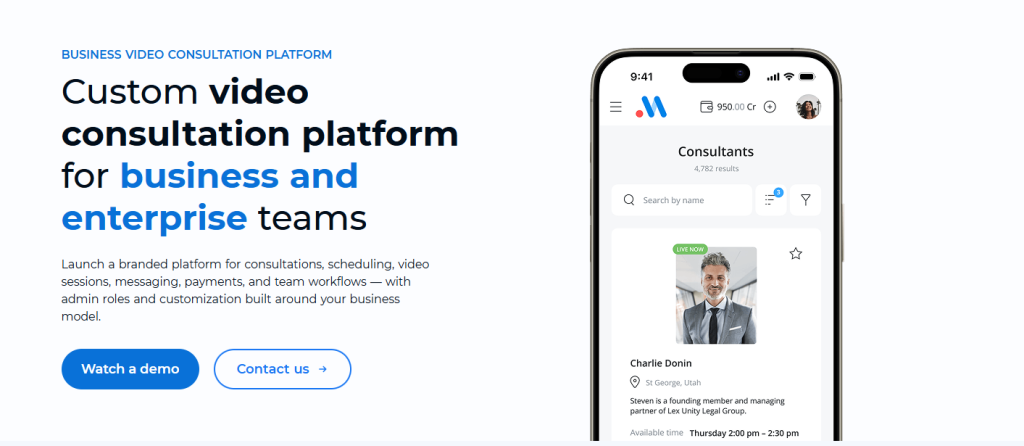
At this point, the trade-offs are clear. Building everything from scratch gives full control, but it takes time, budget, and a solid technical team. For many teams, that means months before the first real consultation happens. SaaS tools go in the opposite direction. You can launch quickly, but you’re locked into someone else’s structure, branding limits, and feature roadmap.
This is where Scrile Meet comes in. It’s built as a custom white-label development solution, which means you’re not adapting your business to the tool. The product is shaped around how you want to operate.
What you actually get in practice:
- fully branded telemedicine service under your own domain, so users interact with your business, not a third-party platform
- built-in video consultations that are ready to use without setting up complex infrastructure or external tools
- integrated scheduling and calendar logic that keeps availability, bookings, and sessions aligned automatically
- payment handling inside the system, allowing you to charge per session or run subscription-based services without extra integrations
- messaging and follow-up flows that help maintain patient relationships beyond a single consultation
- customizable workflows that adapt to solo doctors, clinics, or more complex multi-provider setups
The result is simple. You launch faster because the core is already built, but you keep ownership and flexibility as your service grows.
What’s the Right Way to Build?
| Approach | Time to Launch | Cost | Flexibility | Best For |
| Build from scratch | Long | High | Full | Funded startups |
| SaaS tools | Fast | Low | Limited | Testing ideas |
| White-label solution | Medium | Moderate | High | Real business |
The choice comes down to your current stage, not your ambitions. If you have funding, a technical team, and a long-term roadmap, building from scratch gives full control, but it demands patience and ongoing investment. SaaS tools make sense when you’re validating an idea quickly or testing a niche without committing resources upfront.
If the goal is to launch a real service, start generating revenue, and still keep control over branding and workflows, a white-label approach sits in the middle. It removes months of development while avoiding the limitations of generic tools. Most teams that plan to grow beyond a simple MVP end up moving in this direction anyway, just later and at a higher cost.
Conclusion
Telemedicine isn’t a side feature anymore. It’s infrastructure for modern healthcare services, and the opportunity is only growing. But results don’t come from ideas alone. Execution, clarity, and the right product decisions are what actually turn this into a working business.
If you’re serious about how to develop a telemedicine app, the key is choosing the right path from the start. It affects how fast you launch, how much you invest, and how flexible your product will be as it grows.
If you want to move from idea to real service without getting stuck in long development cycles, it makes sense to start with a solution built for that purpose. Explore Scrile Meet and see how you can launch a fully branded telemedicine platform under your own name.
FAQ
How long does it take to develop a telemedicine app?
A focused MVP usually takes 3 to 5 months. That covers video consultations, scheduling, payments, user profiles, and basic admin tools. A larger product with mobile apps, complex workflows, EHR integrations, and advanced security can take 6 to 12 months.
How much does a telemedicine app cost in 2026?
A practical MVP usually starts around $30,000–$80,000. A full custom product can reach $100,000–$150,000+ depending on features, compliance needs, integrations, and design complexity. Video infrastructure, backend logic, and security are usually the biggest cost drivers.
What features should a telemedicine app include first?
Start with video consultations, appointment scheduling, payments, patient profiles, provider accounts, notifications, and basic admin controls. Messaging and follow-ups are also useful early. Advanced analytics, AI triage, and integrations can wait until the service has real users.
Does a telemedicine app need HIPAA or GDPR compliance?
Yes, if it handles protected health data in regulated markets. HIPAA applies in the US, while GDPR applies to users in the EU. Compliance affects storage, access control, encryption, consent, audit logs, and vendor selection. It should be planned before development starts.
Can a small business launch a telemedicine service?
Yes. A small clinic, solo provider, or niche health startup can launch with a focused feature set. The key is to avoid building a huge product first. Start with one audience, one monetization model, and one clear workflow that users can understand immediately.
How do telemedicine apps make money?
Common models include pay-per-session, monthly subscriptions, clinic packages, corporate wellness plans, and paid follow-ups. Some services combine several models later. The simplest starting point is usually paid consultations, because revenue is tied directly to completed appointments.
Is it better to build from scratch or use a white-label solution?
Building from scratch gives full control, but it takes longer and costs more. SaaS tools are faster, but often limit branding and workflows. A custom white-label solution works well for businesses that want ownership, faster launch, and flexibility without starting from zero.
What is the biggest mistake when developing a telemedicine app?
The biggest mistake is building too much before proving demand. Many teams spend months on features users never request. A better approach is to validate the niche early, launch core functionality, collect feedback, and improve around real consultations.

Polina Yan is a Technical Writer and Product Marketing Manager, specializing in helping creators launch personalized content monetization platforms. With over five years of experience writing and promoting content, Polina covers topics such as content monetization, social media strategies, digital marketing, and online business in adult industry. Her work empowers online entrepreneurs and creators to navigate the digital world with confidence and achieve their goals.