
Quick answer
A creator membership referral program rewards existing fans for introducing qualified paying subscribers. Start with a capped credit or access benefit, qualify referrals only after payment checks, and fund rewards from an explicit contribution budget. Record attribution, reward timing, refunds, and creator funding in a shared worksheet before implementation. Judge the pilot by incremental contribution, not invitation volume.
Design a creator membership referral program around qualification
A fan can bring a friend who pays and cancels before the reward arrives. A creator membership referral program needs to distinguish that introduction from an earned reward. For a small platform, start by rewarding a verified paid membership, with a capped liability and a clear funding owner.
This member-to-member loop lets fans share personal invitations and earn access, credits, discounts, or status. The decision is whether you can fund those promises without charging creators who never approved them. Professional affiliate partnerships and negotiated commissions belong in a separate program with different contracts and accounting.
Consider a hypothetical multi-creator photography community. Its operator initially wants to give fans a free membership month whenever an invited friend subscribes. The attraction is obvious: the benefit matches what members already buy. The discovery comes at settlement. Subscription receipts also fund creator earnings and payment costs; giving away their face value spends money the platform does not keep.
Match the benefit to its fulfillment obligation. Credits reduce future bills; discounts reduce the referred purchase; access adds entitlements; status adds recognition. None is automatically free. A critique session consumes creator time, while a public badge can expose membership someone considers private. Offer private recognition where that exposure would discourage invitations.
For the photography community, a capped renewal credit is easier to value than an unrestricted free month across differently priced creators. Specify eligible purchases, expiry, and whether balances can combine with other promotions before announcing it. If the benefit crosses access levels, creator membership tier design helps resolve which entitlements the reward actually grants; the referral rules should inherit those boundaries.

Use a referral-economics worksheet before setting rewards
Set the maximum incentive from contribution remaining after creator earnings, processing, servicing, and the reserve you intend to keep. Count both sides of a referral offer together. A reward ceiling is a spending boundary, not evidence that the offer will generate additional subscribers.
Use a declared accounting horizon and a consistent unit: contribution per qualifying referred subscriber over that horizon. Begin with collected receipts after refunds, subtract creator earnings and variable payment and service costs, then subtract your required contribution reserve. The remainder is the incentive ceiling. Fixed software and operating costs still need funding; the reserve must reflect that obligation rather than treating all remaining contribution as disposable.
| Decision | Pilot rule | Accounting or implementation consequence |
|---|---|---|
| Qualifying event | New subscriber; first payment settled and unreversed at release | No reward for registration or a free trial alone |
| Attribution | Hypothetical setting: first valid invite accepted within 30 days | Store inviter, acceptance time, campaign version and purchase |
| Reward timing | Hypothetical setting: release 30 days after settlement | Show pending status; inspect refunds before release |
| Cancellation and clawback | Cancellation alone keeps earned credit; refund reverses it | Revoke unused credit; review consumed credit separately |
| Funding | Platform funds reward; creator earnings unchanged | Separate promotion expense from creator payable |
| Abuse controls | Exclude self-referrals; review linked accounts and payment reuse | Hold suspicious rewards for review with an appeal route |
| Ceiling | Hypothetical inputs: $20 receipt less $14 creator share, $1 costs, $2 reserve | Maximum combined incentive: $3 per qualified subscriber |
| Selected reward | Hypothetical setting: $2 inviter credit; no invitee discount | Value full credit liability; do not assume expiry savings |
Platform-funded rewards leave creator payables intact. Creator-funded benefits need explicit participation and a defined debit, including when a member renews elsewhere. Connect promotion records to creator payout reconciliation so finance can explain each expense without confusing it with earnings.
Budget the full redeemable credit value. Expected expiry can inform later forecasts, but forgotten rewards make a fragile launch plan. Restrict pilot credit to otherwise paid purchases and preserve creator payouts. If that allocation cannot be implemented, change the offer before inviting members.
Attribution decides which invitation gets credit; the holding period decides when a reward becomes usable. In this proposed pilot, a late purchase can qualify if invitation acceptance was timely. Publish any purchase deadline separately. Store acceptance server-side so a device change does not replace the inviter.

Test the free-month idea against retained contribution
In the hypothetical photography community, the free-month offer exceeds the platform-funded incentive ceiling. A smaller credit fits the declared budget. That establishes affordability under the assumptions; it does not establish that the referral caused the purchase.
Use these hypothetical assumptions throughout the example: a qualifying subscriber pays $20 for the initial month, the creator receives $14, and payment plus variable service costs total $1. There are no taxes, refunds, or other variable costs in this completed qualifying transaction. The operator requires a $2 contribution reserve. The worksheet therefore allows $3 for the combined inviter and invitee incentive.
Under those hypothetical assumptions, pre-incentive contribution is $20 minus $14 minus $1, or $5. Subtracting the $2 reserve gives the $3 ceiling. The initial free-month idea is valued at its hypothetical $20 face value because it displaces an otherwise paid renewal while preserving creator earnings. That would leave negative $15 of contribution attributable to the referral offer, well below the required reserve.
The revised hypothetical offer grants the inviter a $2 renewal credit and gives the invitee no discount. Its conservative cost is $2, leaving $3 contribution after the reward, which exceeds the $2 reserve. The invited subscriber still pays $20 and the creator still receives $14. Credit redemption belongs to the inviter’s later invoice; allocate its cost to this referral cohort once, rather than deducting it again when reporting the same cohort.
This comparison excludes future renewals. Hoped-for lifetime revenue does not resolve whether renewals will happen. If you extend the horizon, update creator earnings, processing, servicing, refunds, and rewards across that same period. Never compare initial-month contribution with a reward justified by indefinite membership revenue.
Even an affordable credit can subsidize a friend who was going to subscribe anyway. Run a limited pilot with an invitation-eligible group and a comparable group without the incentive, keeping ordinary sharing available. Compare contribution per eligible member across the same observation period, including non-referrers. Attributed subscribers explain reward entitlement; the difference between groups helps estimate incremental value. Small samples warrant caution rather than a victory announcement.

Make cancellations, abuse, and privacy change the workflow
Reward eligibility must survive refunds, repeated payment events, and account changes. Use separate pending, earned, redeemed, and reversed states. Cancellation stops a future subscription; a refund changes the transaction that funded the reward. Treating them identically creates avoidable disputes.
For the proposed pilot, cancellation after qualification does not revoke an earned credit when the qualifying payment remains collected. A refund or chargeback on that payment reverses unused credit. If the credit was already spent, flag a recoverable promotion loss for review; do not automatically debit a member’s card or reduce unrelated creator earnings. Explain the treatment in member terms and decide who can authorize exceptions.
Use a unique qualifying payment identifier and a database constraint to block duplicate rewards. Retried webhooks must return the existing outcome. Keep an append-only history of attribution, release, redemption, and reversal with its policy version. Checkout redirects do not prove settlement; the payment integration must supply the events eligibility requires.
Exclude self-referrals and repeated rewards for the same referred account. Linked identities, reused payment details, or invitation bursts can trigger review. A shared IP address alone is not proof of abuse. Give administrators evidence and reason codes, and offer an appeal without revealing another member’s personal details.
Make sharing deliberate. Referral links should identify invitations without exposing email or sensitive subscription history. Avoid default address-book uploads. Show inviters reward status, not friends’ billing details. For sensitive memberships, private credits may work better than a public leaderboard that discourages participation.
Pause the incentive if you cannot identify settled qualifying payments, reverse unused benefits, or distinguish promotion expense from creator payables. Access rewards also fail when they promise scarce creator attention without capacity approval. A creator platform agreement checklist helps settle funding and benefit obligations before implementation; a referral campaign cannot repair an agreement that leaves those responsibilities ambiguous.

Implement the smallest auditable referral loop
Approve the worksheet, then test the payment-to-reward lifecycle before building campaign features. Your next action is a sandbox demonstration in which an invited purchase earns a pending reward, a duplicate event changes nothing, and a refund prevents release.
- Approve the qualifying event, attribution precedence, funding owner, reward ceiling, release rule, and reversal treatment as a versioned policy.
- Map invitation, account, payment, creator payable, and credit identifiers. Define who can inspect records, override holds, and approve exceptions.
- Implement invitation acceptance and reward states, then test successful payment, duplicate delivery, cancellation, refund, and disputed payment paths.
- Release a capped pilot to eligible members. Track contribution, outstanding credit liability, review workload, and exceptions before expanding access.
Ask the developer to replay a payment event: the balance must stay unchanged. Refund before release: no spendable credit should appear. Redeem credit, then reverse the qualifying payment: inspect the recorded loss. Verify creator payables against the funding rule throughout.
Consider custom development when existing billing cannot express your attribution or funding rules. A coding assistant can scaffold invitations, but generated code still needs transaction integrity, permission checks, and event-replay verification. Ask vendors to demonstrate those behaviors. A referral dashboard screenshot demonstrates a screenshot.
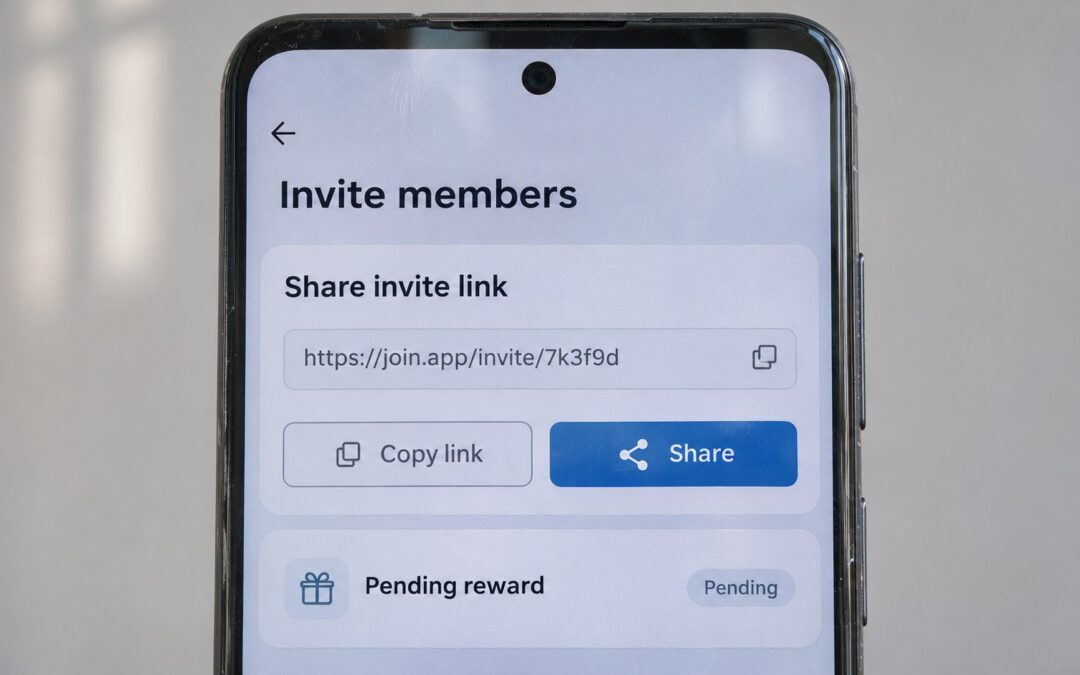
Members need a share action, eligibility terms, pending and usable balances, and reasons for holds. Administrators need event history and controlled overrides. Use creator platform admin dashboard requirements to scope review tools so support can reconstruct each financial decision.
The photography community now has a concrete decision: platform-funded renewal credit, preserved creator earnings, delayed release, and a conservative contribution test. Keep the worksheet beside the backlog. Expand after the pilot supports incremental value and manageable exceptions. Evaluate the underlying subscriptions, access, payments, and earnings management before commissioning the referral extension.

Choose the membership foundation before the referral extension
Scrile Connect provides hosted, white-label software for branded creator platforms with subscriptions, paid content, messaging, and creator earnings management. It uses a fixed software fee with no Scrile platform commission; payment-provider fees remain separate.
Bring the referral worksheet to a platform discussion and verify which rules require configuration, integration, or custom development. Explore Scrile Connect through the linked development guide to evaluate the membership foundation before committing to the referral extension.
Frequently asked questions
What qualifies as a successful member referral?
Define it in the program policy. The proposed approach requires a new subscriber, accepted attribution, and a settled qualifying payment that remains unreversed at reward release. Registration alone does not establish a funded reward.
Should both the inviter and the new subscriber receive a reward?
Only if their combined cost fits the incentive ceiling. An invitee discount consumes the same contribution budget as the inviter’s credit. Test whether the extra benefit produces incremental contribution before adding it.
How long should referral attribution last?
Choose a window that fits the invitation journey and state what it measures: link click, invitation acceptance, or purchase. The proposed worksheet measures acceptance and keeps reward release on a separate clock.
Does cancellation mean the reward must be clawed back?
Not under the proposed policy when the qualifying payment remains collected. A refund or chargeback changes the funding transaction and triggers reversal of unused credit. Explain consumed-credit treatment before launch.
Can creators pay for member referral rewards?
Yes, as an explicitly agreed program design. Define participation, eligible purchases, the creator debit, and refund treatment. Platform-funded rewards should not silently reduce the creator’s agreed earnings.
How can a platform prevent self-referrals?
Block rewards tied to the referring account and review suspicious identity or payment reuse. Combine signals with manual review and an appeal route; a shared network alone cannot distinguish abuse from a household.
Which metric shows whether the program is working?
Use incremental contribution per eligible member over a declared observation period. Track reward liability and review costs alongside it. Attributed purchases alone cannot show whether members would have joined without the incentive.
Does Scrile Connect include this exact referral workflow?
Confirm referral attribution, reward states, credit redemption, and reversal requirements during scoping. Scrile Connect provides the underlying branded membership, paid-content, messaging, and creator earnings software; the proposed referral workflow needs separate verification.

Builds SaaS platforms for content creators, agencies, and entrepreneurs. Writes about the business mechanics behind creator-economy products and how custom software actually ships.