

Quick answer
A creator discovery platform should help fans narrow a catalogue through categories and search, then broaden it through recommendations, editorial collections, and carefully limited popularity signals. For an early marketplace, start with explicit profile data and manual curation rather than pretending sparse behavior is intelligent. Reserve exposure for new and under-seen creators, measure successful discovery beyond clicks, and give operators the controls to correct thin data, gaming, and unsafe results.
When a creator discovery platform becomes necessary
Build discovery when fans arrive to explore several creators, not merely to reach one person they already follow. The business decision is whether your catalogue behaves like a directory, where users know what to request, or a marketplace, where the platform must create a credible match.
A directory can survive with profile pages, categories, and exact-name search. A marketplace cannot. Fans may know a topic or format but not a creator, while new creators lack the engagement history that would earn prominent placement. Sorting by raw popularity appears objective yet rewards previous exposure with more exposure. The resulting loop makes the homepage predictable, weakens the long tail, and gives recruits little reason to stay.
The first decision is therefore not which recommendation model to buy. It is what a good match means for your niche. Define eligibility before ranking: profile completeness, permitted content, active status, available offer, language, region where relevant, and moderation clearance. Then define relevance using attributes fans can understand. A fitness marketplace might use training style and experience level; a coaching marketplace might use specialty and session format. If those fields are vague, clever ranking merely automates vague results.
Validate the vocabulary with real supply and real fan requests before coding deep personalization. The process for how to validate a creator platform niche helps founders test whether categories reflect buyer intent rather than internal enthusiasm. The next action is to write sample fan queries and verify that each can produce several eligible, meaningfully different profiles.

Consider a niche platform for independent music teachers. A fan asking for beginner vocal coaching needs filters for discipline, teaching format, language, and availability; follower count is secondary. A fan browsing performances may care more about genre and fresh releases. Those journeys should not share an identical ranking. If the team cannot describe which attributes change the order for each journey, it is too early to build personalized recommendations. Instrument the journeys separately, keep the initial logic inspectable, and review failed searches as product research rather than treating an empty result as a harmless edge case.
Use a ranking matrix, not one universal score
The safest early design separates retrieval from ranking. First retrieve eligible candidates that match the fan's intent; then order them using relevance, quality, freshness, controlled popularity, and exploration. Different surfaces should use different mixes because search, a category page, and a discovery feed solve different questions.
| Surface | Primary job | Lead inputs | Required safeguard |
|---|---|---|---|
| Search | Satisfy stated intent | Query match, filters, profile quality | Do not let popularity override a strong match |
| Category | Make a niche browsable | Taxonomy fit, activity, freshness | Rotate eligible profiles within relevance bands |
| Recommendations | Extend known interest | Content affinity, prior actions, format | Include unfamiliar and under-exposed candidates |
| Editorial collection | Create context or trust | Human theme, quality review, timing | Record ownership and expiry |
| Popular now | Show current momentum | Recent qualified engagement | Use a limited window and resist manipulation |
Treat popularity as evidence, not entitlement. Qualified engagement can help distinguish a useful profile from an abandoned one, but lifetime totals are a poor default because they preserve incumbency. Freshness should decay, quality gates should precede ranking, and exploration should deliberately test creators with insufficient exposure. Randomness without eligibility is not fairness; it is merely disorder wearing an egalitarian hat.
Document each surface as a policy: candidate source, exclusions, ordering inputs, tie-breaker, refresh event, and manual override. This becomes a testable contract for developers and operators. The immediate action is to choose the lead input and safeguard for every surface in the matrix before selecting search infrastructure or a recommendation service.

How should cold-start discovery work?
Give every eligible new creator a controlled chance to gather evidence. Cold-start treatment should be a temporary operating state with entry requirements, exposure opportunities, evaluation signals, and an exit rule—not an unrestricted homepage boost.
Start with structured onboarding. Collect the attributes used by retrieval, verify the profile and offer, and require enough representative content for a fan to judge the proposition. Place approved newcomers in relevant category rotations and themed collections, then compare their results only after they have received meaningful eligible exposure. Evaluate actions that indicate fit, such as profile depth, follows, saves, qualified conversations, purchases, or subscriptions; a thumbnail click alone can reward spectacle rather than satisfaction.
Worked example: assume, hypothetically, that a new yoga instructor offers live beginner sessions in Spanish and has no platform behavior yet. Search can retrieve the profile for Spanish beginner yoga because those facts are explicit. A category carousel can rotate the instructor among other qualified beginner profiles. An editorial collection can feature newly verified live teachers. The system should not infer broad popularity, and it should not bury the profile for lacking historical sales. Once sufficient exposure produces useful behavior, ordinary ranking can gradually replace the cold-start treatment.
Discovery quality therefore begins upstream. A disciplined creator onboarding workflow supplies consistent fields, verification states, preview media, and offer data; missing inputs should reduce eligibility for the affected surface rather than generate invented relevance. The next action is to map every ranking field to its owner, validation rule, and fallback.

Measure discovery without rewarding incumbency
Judge discovery by whether fans reach relevant, varied creators and complete valuable actions—not by aggregate clicks alone. Track the funnel by surface and cohort, then pair outcome metrics with exposure-distribution checks so a conversion gain cannot conceal a shrinking marketplace.
- Retrieval health: failed queries, thin result sets, filter abandonment, and missing catalogue attributes.
- Match quality: profile depth, follows, saves, qualified interactions, purchases, subscriptions, and early reversals.
- Supply health: eligible creators receiving impressions, repeated concentration among leaders, and exposure for newcomers or under-seen profiles.
- Experience quality: hidden profiles, reports, blocked recommendations, and manual corrections by surface.
Read these measures together. Higher clicks with more hides suggests attractive packaging and poor fit. More transactions with exposure collapsing onto familiar profiles may improve the present period while weakening future supply. Broad exposure without meaningful actions means the system is distributing attention, not discovering relevance. Break results down by category, acquisition source, new versus established creators, and logged-in versus anonymous visitors; aggregate averages are excellent places for product problems to hide.
Separate discovery from acquisition as well. A fan acquisition strategy for creator platforms brings people into the marketplace; discovery determines whether those visitors find someone worth following or paying. The next action is to create a recurring review that pairs fan outcomes with creator exposure and assigns every anomaly to a product, taxonomy, moderation, or supply owner.

What should you build first, and where does it fail?
Implement discovery in dependency order: trustworthy catalogue data, retrieval and filters, surface-specific ranking, controlled exploration, measurement, and only then deeper personalization. This sequence produces a useful system before behavioral data becomes rich enough for machine-led recommendations.
- Define fan journeys, eligibility rules, taxonomy, and moderation states.
- Build exact search, forgiving query handling, categories, filters, and useful empty-result recovery.
- Add transparent ordering rules for search, category pages, new arrivals, editorial collections, and current popularity.
- Introduce cold-start rotation, diversity constraints, override controls, and decision logs.
- Instrument exposure, downstream actions, safety feedback, and cohort reporting; test one policy change at a time.
- Add behavioral recommendations only when data is sufficient, consent and privacy choices are clear, and simpler rules no longer answer the decision.
This blueprint does not fit every product. A single-creator site needs navigation and content access, not marketplace allocation. A tiny curated roster may be better served by editorial pages. Highly regulated or safety-sensitive categories may require human approval before any algorithmic placement. Anonymous traffic also supports less personalization, and sparse niches may need broader categories or more supply rather than smarter ranking. Software cannot recommend what the marketplace does not have.
Founders planning onlyfans clone app development should scope discovery alongside profiles, monetization, moderation, and operations rather than bolt it onto a finished feed. The verifiable next action is a discovery policy document plus acceptance tests showing who is eligible, why profiles appear, how newcomers receive exposure, and what operators can change.
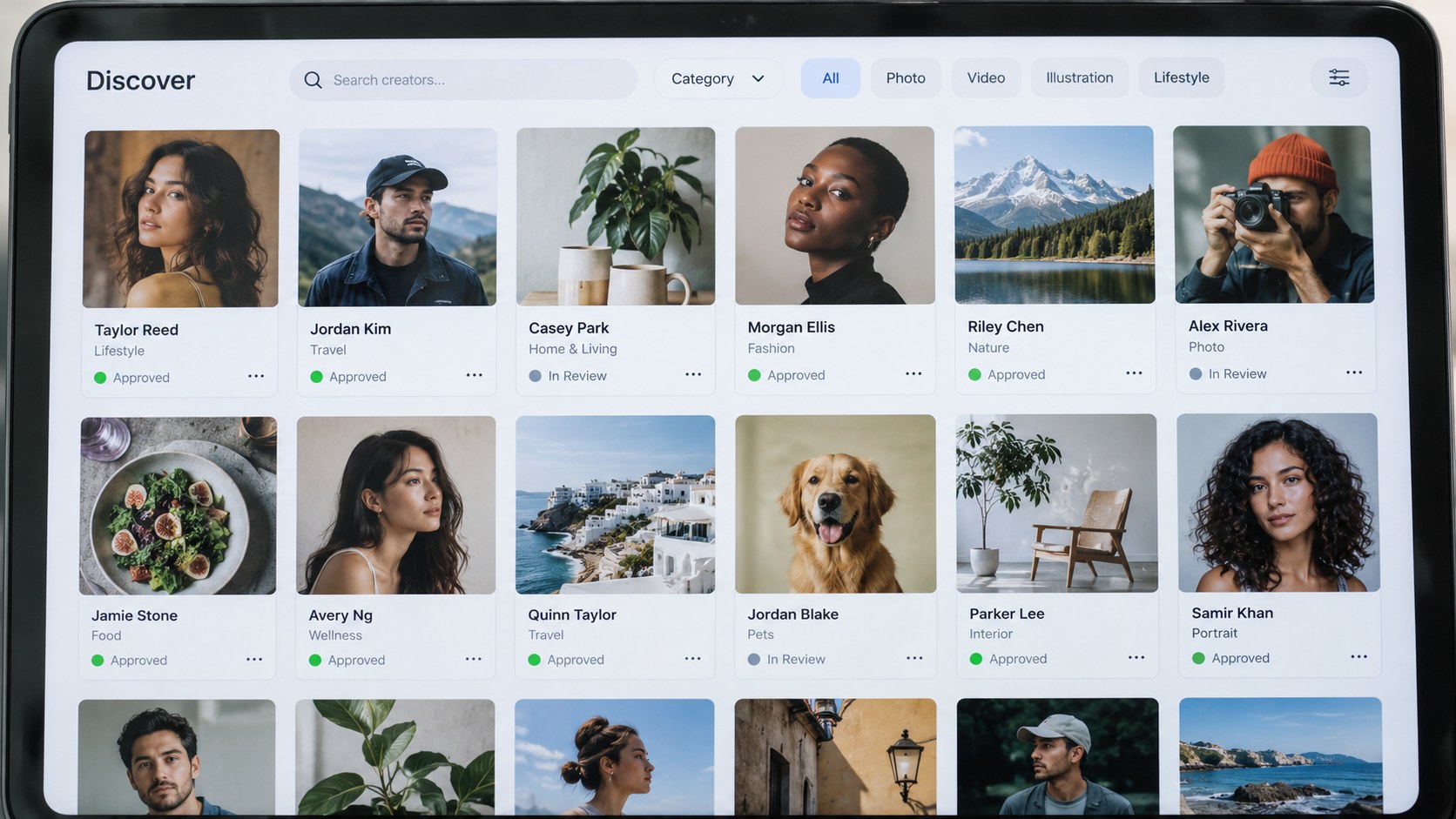
Launch monetization and discovery on owned infrastructure
Discovery earns its place only when the underlying platform can turn a relevant match into a paid relationship. Scrile Connect is a white-label content monetization platform for branded sites, with subscriptions, tips, pay-per-view content, paid interactions, livestreams, video calls, payment options, administration, analytics, moderation, and age-verification support.
For founders who need an owned domain, configurable rules, creator management, and monetization without building the entire foundation from zero, Scrile Connect provides the operating base. Custom features and API integrations can then implement the discovery policy your niche actually requires.
Frequently asked questions
What is a creator discovery platform?
It is a multi-creator product that helps fans find relevant profiles or content through search, categories, filters, recommendations, editorial collections, and popularity-based surfaces.
Does a new creator marketplace need AI recommendations?
Usually not at launch. Structured profile data, useful taxonomy, transparent ranking rules, controlled rotation, and editorial curation can produce better decisions while behavioral data remains sparse.
How can a platform avoid favoring popular creators forever?
Limit the influence of lifetime popularity, emphasize recent qualified behavior, reserve controlled exposure for eligible under-seen creators, and monitor how impressions concentrate across the catalogue.
What data should creator search use?
Use verified profile and offer attributes relevant to fan intent, such as topic, format, language, availability, access model, activity state, and moderation eligibility.
How should new creators enter recommendations?
Require complete, eligible profiles, place them in relevant rotations or collections, gather meaningful exposure, evaluate downstream actions, and graduate them into ordinary ranking when evidence becomes sufficient.
Which creator discovery metrics matter most?
Combine retrieval health, downstream fan actions, creator exposure distribution, safety feedback, reversals, and manual interventions. No single click or conversion measure describes marketplace health.
When should discovery be manually curated?
Use curation when data is sparse, themes require context, safety needs judgment, or a temporary event matters. Record the owner, reason, and expiry for every intervention.
Should discovery be built into an MVP?
Yes when the MVP has multiple creators and exploratory fan traffic. Start with categories, search, eligibility, simple ranking, cold-start exposure, and measurement; postpone complex personalization.

Builds SaaS platforms for content creators, agencies, and entrepreneurs. Writes about the business mechanics behind creator-economy products and how custom software actually ships.