
AR in Fashion 2026: Best Ideas from Top Brands
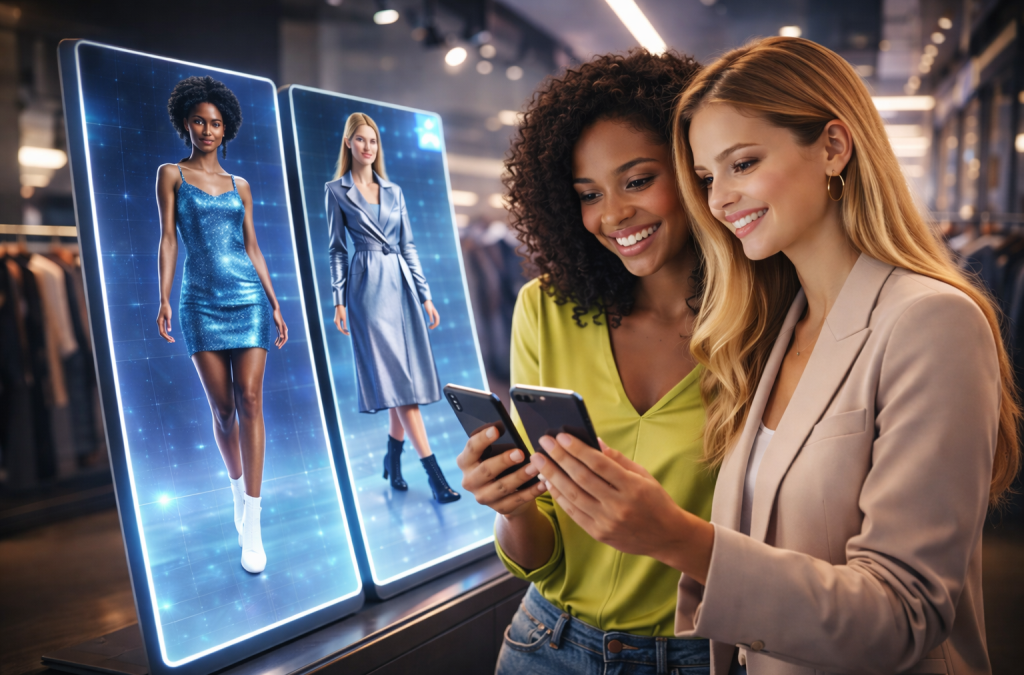
AR in fashion means using Augmented Reality to preview clothing, accessories, and fashion experiences through smartphones or apps. Brands use AR for virtual fitting rooms, interactive retail campaigns, immersive runway shows, and product visualization before purchase. Companies like Gucci, Nike, and Burberry already experiment with Augmented Reality clothing tools to improve online shopping and storytelling.
Fashion rarely ignores new technology for long. Augmented reality has quickly moved beyond experimental marketing and into practical retail tools. Designers and retailers now use AR to change how people discover clothing, evaluate products, and interact with fashion content.
The rise of AR in fashion accelerated once smartphones gained stronger cameras and reliable AR frameworks. At first, brands experimented with playful filters on social media. Today the same technology supports real shopping experiences. A customer can point a phone at their feet and see virtual sneakers appear instantly. A luxury handbag can be placed on a table through the camera view to preview its size and style.
Fashion shows have also begun mixing physical collections with digital elements visible through mobile devices.
Retailers noticed another advantage quickly. AR reduces uncertainty during online shopping. Instead of relying only on product photos, customers can visualize how items might look before placing an order.
These experiments are shaping a new category of Augmented Reality for fashion experiences that connect marketing, product discovery, and digital commerce.
From Runway to Smartphone: How AR Is Transforming Fashion

The influence of AR in fashion reaches far beyond marketing experiments. It now affects several layers of the industry, from product discovery to how brands present collections and interact with customers.
New shopping behavior
One of the biggest shifts appears in shopping behavior. Online buyers increasingly want to visualize clothing before committing to a purchase. Static product photos are no longer enough. Augmented reality gives shoppers a way to see items in a real environment through their phone camera.
Common examples include:
- shoes visualized directly on the user’s feet
- sunglasses placed on the face through camera tracking
- handbags displayed on a table or next to the body for size comparison
This shift explains why AR fashion tools now appear inside brand apps, social media platforms, and even e-commerce websites. Customers expect interactive previews rather than simple images.
From marketing experiment to retail tool
Not long ago AR was used mostly for short promotional campaigns. Brands released playful filters or limited digital experiences designed to attract attention.
Today the technology supports real retail processes. Many companies treat AR as part of their shopping infrastructure.
Some common implementations include:
- virtual fitting rooms inside shopping apps
- interactive store mirrors that suggest outfit combinations
- mobile AR catalogs where customers explore collections in 3D
Research referenced by Netguru shows that AR fitting technology can increase purchase confidence while reducing return rates in apparel e-commerce.
As adoption expands, Augmented Reality apparel experiences are becoming part of the standard shopping journey rather than a separate marketing feature.
Best AR Fashion Ideas Used by Top Brands
People interact with AR in fashion more often than they realize. It appears inside shopping apps, social media filters, and even physical stores. Sometimes the technology is obvious, like a digital fitting room. In other cases it sits quietly behind a camera icon that lets the customer preview a product.
Instead of imagining how something might look, shoppers can place items into their real surroundings. A phone becomes a kind of lens where clothing and accessories appear digitally on top of the physical world.
Virtual try-ons
Digital try-ons remain the most recognizable form of Augmented Reality for clothing. A camera tracks the body, face, or feet, and software positions a digital item over the live image.
The effect is simple but powerful. Instead of looking at product photos, the user interacts with the item.
Typical AR try-on scenarios include:
- glasses aligned with the face through head tracking
- sneakers visualized on the floor and aligned with the user’s feet
- handbags positioned near the body to understand size and proportions
Many people now expect this type of preview before buying accessories online. It reduces guesswork and makes shopping feel more interactive.
Another advantage is speed. Trying a digital version of several items takes seconds, while physical fitting requires time, space, and inventory.
AR inside physical stores
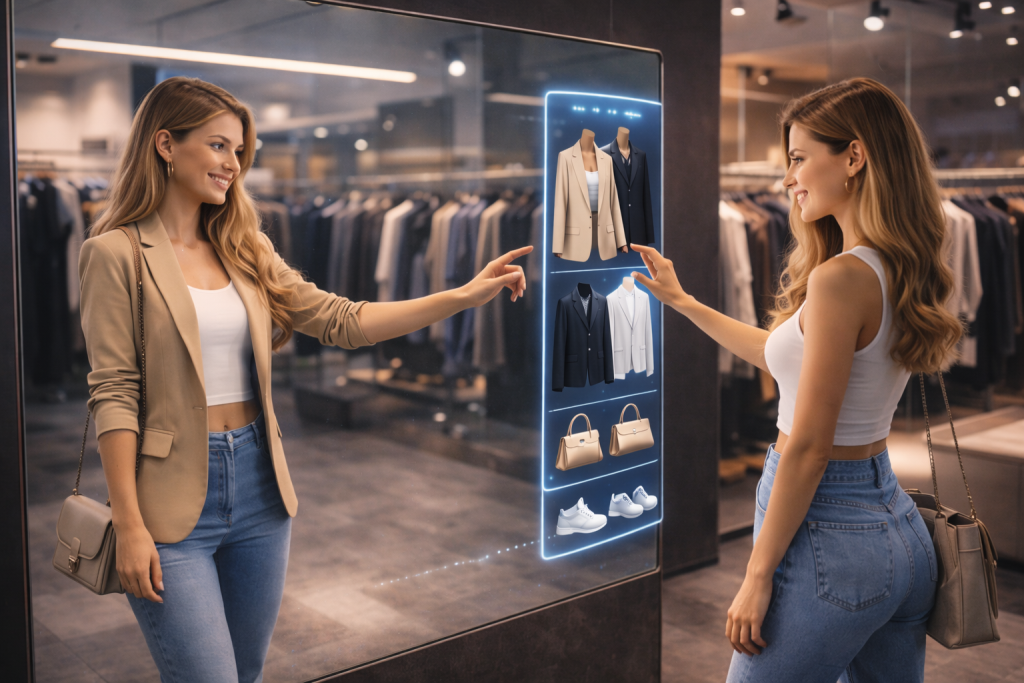
Retail spaces are also experimenting with AR clothing tools. These systems often appear as mirrors or mobile scanning experiences rather than full headsets.
Some stores install smart mirrors that display outfit suggestions after a product is scanned. Others allow visitors to scan clothing tags with a phone and see styling ideas or animations showing how the garment moves.
You might see things like:
- mirrors suggesting alternative color versions of the same item
- scanning points that unlock digital styling tips
- interactive displays showing how pieces work together in an outfit
These features turn browsing into a small discovery process rather than a passive walk through the store.
Social filters and shareable fashion
Another huge driver of AR in fashion comes from social platforms. Camera filters allow people to try digital accessories or clothing elements and share the result instantly.
A short video recorded with a filter can show a virtual jacket, futuristic sunglasses, or a stylized bag that appears in the scene. The person becomes part of the campaign without even realizing it.
This approach blends marketing with entertainment. Instead of watching ads, users play with products.
That combination of try-ons, store experiences, and social filters shows how Augmented Reality apparel has moved into everyday shopping behavior. The technology no longer sits in research labs. It already lives inside the apps people open every day.
Real Brand Experiments That Defined AR Fashion
Several global brands tested different approaches during the past few years. Some focused on digital fitting. Others used AR for storytelling or product visualization. Each experiment explored a different way to connect digital interaction with physical fashion.
Google AI Virtual Try-On

One of the most influential recent developments in AR in fashion comes from Google Shopping. Instead of building a separate fashion app, Google integrated a virtual try-on system directly into its search and shopping experience.
The feature allows users to preview clothing on their own body by uploading a photo. After selecting a product listing, shoppers can tap a “try it on” option and generate an image of themselves wearing the garment. The system uses generative AI to understand body proportions and simulate how fabrics fold, stretch, and drape on different body shapes.
Unlike early AR overlays that simply placed clothing images on top of a body, Google’s approach analyzes the uploaded photo and combines it with product images to generate a realistic visualization of the outfit.
The technology is connected to Google’s massive Shopping Graph, which includes billions of product listings. This means users can experiment with a wide range of apparel without leaving the search interface.
For fashion brands, this marks an important shift. AR experiences are no longer limited to brand apps or marketing campaigns. They are becoming part of the core infrastructure of online shopping.
Gucci virtual sneakers
Gucci experimented with AR inside its mobile shopping app in a way that felt surprisingly practical. Instead of browsing shoes through photos, users could activate the camera and see a digital version of the sneaker appear on their feet. The phone tracked movement and perspective, so the shoe stayed aligned as the person shifted position or changed the viewing angle.
This was not just a visual trick. The feature connected directly to product pages, so the user could move from preview to purchase in the same interface. That small detail changed the role of AR. It stopped being a campaign feature and became part of the buying process. Seeing how a pair of sneakers looked on your own feet removed some of the hesitation that usually appears in online footwear shopping.
Nike Fit
Nike approached AR from a different direction. Instead of visualizing products, the company used smartphone scanning to address a more practical problem: sizing. The Nike Fit tool analyzes the foot using the phone camera and creates a digital measurement model. The app asks the user to stand on the floor, then captures several points that describe the length, width, and shape of the foot.
Those measurements are compared with the dimensions of specific shoe models. The system then recommends the correct size. For a category where returns often happen because of poor fit, this kind of AR clothing technology solves a real retail problem rather than acting as a visual feature.
Burberry product visualization

Burberry tested AR in a quieter but useful way. Instead of focusing on wearables like shoes or glasses, the brand allowed customers to place certain products directly into their surroundings through a phone camera. A handbag could appear on a table, a chair, or next to the person holding the phone.
This small interaction helped answer a simple question: how large is the product in real life? Luxury accessories often look different when seen outside a studio photo. With Augmented Reality apparel previews, customers could check scale and proportions in their own environment before buying.
Zara in-store AR experiment
Zara’s experiment took place inside physical stores. Some locations introduced AR displays that worked through the brand’s mobile app. Customers pointed their phone at specific points in the store and saw digital runway scenes appear on the screen. Models walked across the display wearing pieces from the current collection.
It was a strange experience at first. The store itself looked normal, but the phone revealed an additional layer of movement and styling. Visitors often stood there watching several loops of the animation before browsing the nearby racks.
The goal was not to replace the store environment. Instead, the brand added a storytelling layer that connected the physical collection with a moving digital presentation.
Snapchat collaborations with luxury brands
Snapchat turned out to be one of the most important channels for spreading AR in fashion. Luxury labels began using Snapchat lenses that let users try on accessories directly inside the camera interface. A person could open the app, activate a branded lens, and see sunglasses or jewelry appear instantly on their face.
Because these lenses were shareable, they traveled quickly across social feeds. A user might record a short video wearing the digital item and send it to friends. The interaction functioned both as product preview and informal advertising.
Vogue Business noted that younger shoppers increasingly expect this kind of digital interaction before making fashion purchases.
“A new study created by Vogue Business in collaboration with Snap Inc reveals that 72 per cent of luxury fashion consumers in the UK say it’s important that brands provide AR solutions as part of their shopping experiences…”
What luxury fashion consumers want from augmented reality, Vogue Business
Seen together, these experiments reveal something important. AR in fashion did not evolve through one single format. Some brands focused on fitting, others on sizing, others on storytelling or social sharing. Each project explored a different point where digital interaction could improve the experience of discovering clothing.
Why Brands Invest in AR Fashion

Fashion companies are exploring AR in fashion for several practical reasons. The technology does not only attract attention. It changes how customers interact with products and how brands present collections.
Several benefits explain why more retailers are experimenting with Augmented Reality:
- Stronger customer engagement. AR experiences invite people to interact with products instead of simply looking at photos. When users try items virtually or explore a digital showroom, they spend more time inside the brand’s app or campaign environment.
- Improved product visualization. One of the biggest challenges in online fashion retail is helping customers imagine how an item will look in real life. AR allows shoppers to see garments, accessories, or footwear in context, which often makes the decision process easier.
- Lower return rates. When customers understand size, proportions, and style before ordering, the chances of disappointment decrease. Virtual previews reduce the number of products returned because buyers feel more confident about what they are purchasing.
- Organic marketing through shareable content. AR filters and digital try-ons often spread through social media. Users share photos or short videos of themselves wearing virtual fashion items, which turns customers into participants in the campaign.
Research referenced by Rock Paper Reality emphasizes how visualization affects decision making in fashion retail.
“By creating more informed customer decisions and lower return rates, AR can help stores cut down on return-related expenses.”
Augmented Reality in Fashion, Rock Paper Reality
Another important element is storytelling. Brands can transform clothing into part of an interactive narrative where users explore collections rather than simply viewing them. This mix of retail utility and digital entertainment explains the growing investment in AR in fashion strategies.
Economics Example: How AR Can Reduce Returns
Return rates remain one of the most expensive problems in online fashion retail. In many apparel stores, around 30% of orders eventually come back because customers are unsure about fit, size, or proportions.
Consider a simple scenario. An online clothing store processes 10,000 orders every month, with an average product price of $80. If the typical return rate reaches 30%, that means about 3,000 items are sent back.
Handling those returns is not free. Packaging, inspection, and restocking can easily cost around $8 per returned item.
3,000 returns × $8 handling cost = $24,000 per month
Now imagine the store introduces virtual fitting tools based on AR in fashion technology. If these previews reduce returns by just 20%, the number of returned items drops to 2,400.
2,400 × $8 = $19,200 monthly return costs
That difference creates $4,800 in monthly savings.
For retailers operating at large scale, the financial impact becomes significant. This explains why AR is increasingly viewed as a practical retail tool rather than only a marketing feature.
Launch Your Own AR Fashion Experience With Scrile AI

Most fashion brands meet AR through social platforms first. A filter appears, people try it, the campaign runs for a few weeks, then it disappears. The brand gains attention, but the technology itself remains outside its control. Data, design limitations, and feature updates all depend on the platform that hosts the experience.
Some companies eventually realize that this model works well for promotion but not for long-term digital products. That is where custom development becomes relevant.
Scrile AI works with brands that want to build their own AR fashion environments instead of borrowing someone else’s tools. The idea is simple: the technology adapts to the brand, not the other way around.
With a custom solution from Scrile AI, a fashion company can launch features such as:
- AR fitting apps that allow customers to preview garments or accessories through a phone camera while browsing the catalog. These tools can connect directly to an online store so users move from preview to purchase without leaving the experience.
- Digital showrooms where collections appear in interactive environments rather than static product pages. Visitors can explore items in 3D and see how pieces look together in different settings.
- AI stylists that guide customers through a conversation and display Augmented Reality clothing previews while suggesting outfits or combinations.
- Interactive fashion presentations where avatars, animation, and product visualization create a digital runway or branded experience.
As AR in fashion grows, more companies start looking beyond short promotional filters. A dedicated platform makes it possible to experiment with new formats, control the customer experience, and build something that belongs entirely to the brand.
Decision Guide: Which AR Fashion Format Works Best?
| AR Use Case | Best For | Implementation Effort | Business Impact | Limitations |
| Virtual try-on (mobile camera) | Footwear, eyewear, accessories, cosmetics | Medium – requires body tracking and product models | Improves purchase confidence and can reduce return rates | Works best for rigid products; fabric simulation remains complex |
| AR product visualization | Bags, luxury accessories, fashion items where scale matters | Low to medium | Helps customers understand size and design before buying | Does not fully simulate how garments fit on the body |
| AR store mirrors | Physical retail environments and flagship stores | High – requires hardware installation and software integration | Increases in-store engagement and encourages outfit exploration | Expensive to deploy across large retail networks |
| Social media AR filters | Fashion marketing campaigns and product launches | Low | Creates viral promotion and user-generated content | Usually short-term campaigns with limited commerce integration |
| AR fashion shows / digital runway | Luxury brands, fashion events, digital collections | Medium | Builds brand storytelling and media attention | Less direct impact on sales conversion |
| Custom AR fashion apps | Brands building long-term digital retail experiences | High – requires product modeling, AR development, and platform integration | Full control over customer experience and monetization | Higher development cost and longer implementation timeline |
For many companies exploring AR in fashion, the process starts with simple social filters or product previews. As brands gain experience, they often move toward more advanced solutions such as AR fitting tools or dedicated fashion apps that integrate directly with e-commerce platforms.
Conclusion
Interest in AR in fashion keeps growing because it solves real challenges for both shoppers and retailers. Customers can preview items before buying, which reduces uncertainty in online purchases. Brands gain new ways to present collections and create memorable interactions around their products.
From virtual try-ons to immersive retail experiences, AR is already changing how fashion is discovered and marketed. The next stage will likely combine AR with AI stylists, digital avatars, and personalized fashion recommendations.
Brands that want full creative control usually move beyond third-party tools and build their own experiences. Custom development makes it possible to design unique AR fashion environments that match a company’s identity and retail strategy.
If you want to launch your own AR fashion platform, contact the Scrile AI team and discuss how a custom AR and AI solution can be built specifically for your brand.
FAQ
How is AR used in the fashion industry?
AR in fashion allows customers to interact with clothing and accessories through smartphone cameras or AR-enabled apps. Brands use it for virtual fitting rooms, product visualization, and interactive store displays that help shoppers see how items might look before buying them.
What clothing brands are using augmented reality?
Several global fashion brands experiment with AR technology. Examples include Gucci with sneaker try-ons, Burberry with product visualization, and Zara with AR virtual model experiences in stores. Luxury brands also collaborate with Snapchat to create digital accessory try-ons.
How is AI impacting the fashion industry?
AI helps fashion companies analyze trends, personalize shopping experiences, and recommend outfits. It can also assist designers by simulating how garments behave. Combined with AR, AI enables digital stylists and interactive fashion previews.
What is AR clothing and how does it work?
AR clothing refers to digital garments or accessories that appear on a person through augmented reality technology. Smartphone cameras track the user’s body while software overlays the digital fashion item onto the live video image.
Can augmented reality reduce fashion product returns?
Yes. AR visualization helps shoppers understand size, style, and proportions before ordering. This reduces uncertainty and can lower return rates in categories such as footwear, eyewear, and accessories.
How do fashion brands use AR in marketing campaigns?
Brands use AR to create interactive campaigns such as social media filters, digital runway shows, and virtual try-ons. These experiences encourage users to engage with products and share the content with others.
What technology is required to build AR fashion apps?
AR fashion apps rely on smartphone cameras, computer vision technology, and development frameworks such as ARKit or ARCore. These tools allow applications to track movement and place digital clothing accurately in the user’s environment.
Can brands create their own AR fashion platforms?
Yes. Brands can build their own AR fashion platforms instead of relying on third-party filters. Custom solutions developed by companies like Scrile AI allow businesses to launch AR fitting tools, AI stylists, and interactive digital showrooms.

Polina Yan is a Technical Writer and Product Marketing Manager, specializing in helping creators launch personalized content monetization platforms. With over five years of experience writing and promoting content, Polina covers topics such as content monetization, social media strategies, digital marketing, and online business in adult industry. Her work empowers online entrepreneurs and creators to navigate the digital world with confidence and achieve their goals.