
How much does it cost to create an app? Most projects fall into three practical ranges. Basic MVP apps usually cost $5,000–$50,000. Business apps with accounts, integrations, and dashboards often land between $40,000 and $200,000. Complex platforms such as social networks, fintech tools, or video streaming apps can require $200,000–$500,000+. The final budget depends on feature complexity, integrations, design depth, and developer rates in different regions.
Someone with an app idea usually asks the same question early in the process: how much does it cost to create an app? The short answer sits somewhere between a few thousand dollars and several hundred thousand. The wide gap surprises many first-time founders. A simple utility app built by a small team may cost $5,000–$50,000. A typical business product with user accounts, backend logic, and integrations often lands between $40,000 and $200,000. Products that handle video streaming, large social feeds, payments, or AI recommendations can move past $300,000–$500,000, and large platforms sometimes cross the $1 million mark.
The difference comes from practical factors. Feature sets drive most of the work. A social media feed, a real-time chat system, or a video platform demands far more engineering hours than a simple tool. Design quality adds time. Security requirements add time. Integration with services such as Stripe, Google Maps, or streaming infrastructure also expands the scope.
Developer location affects the final number as well. Teams in the United States often charge $120–$200 per hour. Many European studios work in the $50–$120 range. Some Asian teams operate closer to $25–$60 per hour.
This guide walks through real budgets, typical development stages, and examples across categories such as social media apps, video platforms, e-commerce tools, and fintech products.
Why App Development Prices Vary So Much

People keep asking the same question, how much does it cost to create an app, and the answers rarely match. One startup hears $20,000. Another receives an estimate closer to $400,000. Both numbers can be correct because the scope behind the word “app” changes dramatically.
Many early estimates look confusing because they hide the structure of the work. Development teams break a project into dozens of tasks. Each feature requires design, backend logic, testing, and ongoing maintenance. A login screen takes a few hours. A real-time video chat system may take weeks of engineering and infrastructure setup.
Industry research often summarizes this with a wide range.
“The cost to build a mobile app varies widely, but averages between about $5,000 and $250,000 depending on complexity, features, and development choices.”
Speednet mobile app development cost research by Adam Rasiewicz
That range reflects the amount of engineering work involved rather than random pricing. A small app might require a few hundred development hours. A full-scale platform with messaging, payment flows, moderation tools, and analytics dashboards can easily reach 2000–3000 hours of work.
Two factors shape most budgets: the number of features inside the product and the location of the development team.
Feature Complexity

The type of features inside the product determines how many hours engineers need. A basic utility app may contain only a few simple elements.
Typical basic features include:
- user registration and login
- personal profiles
- push notifications
- a simple dashboard or settings page
These components rely on well-known frameworks. Developers can implement them quickly because many libraries already exist.
More advanced apps require deeper engineering work. Examples include:
- real-time chat systems
- live video streaming or video calling
- AI-based recommendation engines
- payment processing and subscriptions
- GPS tracking and map navigation
Each of these features adds multiple layers. Video apps need media servers and bandwidth management. Payment systems require security checks and compliance. AI features involve data models and infrastructure for training or inference.
Approximate feature development costs from industry estimates illustrate the difference:
- authentication systems: $5,000–$15,000
- payment integrations: $8,000–$25,000
- AI-powered features: $15,000–$50,000+
When several complex features combine in a single product, the development time grows quickly. A social media platform with messaging, video, and recommendation feeds may require thousands of hours of engineering.
Team Location and Hourly Rates
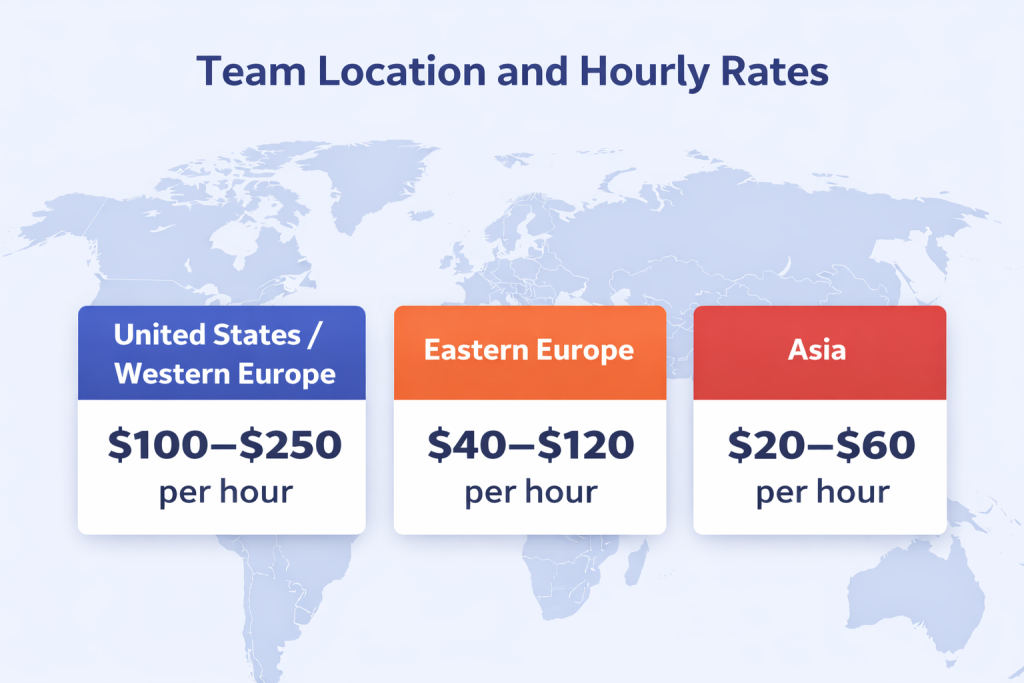
The location of the development team also shapes the final price. Software engineers in different regions charge very different hourly rates.
Typical market ranges look like this:
- United States / Western Europe: $100–$250 per hour
- Eastern Europe: $40–$120 per hour
- Asia: $20–$60 per hour
The difference becomes obvious when looking at a typical project workload.
Example calculation:
- medium complexity app: 1000 development hours
Possible budgets depending on location:
- US team at $150/hour → $150,000
- Eastern Europe team at $70/hour → $70,000
- Asian team at $35/hour → $35,000
The work itself stays similar. The hourly rate changes the outcome. This single factor can shift the final project cost by three to four times.
For that reason, founders often compare development teams across regions before deciding on a partner.
Main Cost Components of Building an App

When founders ask how much does it cost to create an app, many imagine a developer sitting down and writing code for a few months. Real projects follow a longer chain of work. Teams move through several stages before a product reaches the app store. Each stage adds hours, specialists, and tools to the budget.
A typical mobile product includes planning, interface design, backend engineering, testing, and deployment. Ignoring any of these steps often creates problems later. Poor planning leads to feature changes mid-development. Weak testing causes bugs after release. Rushed design can reduce user retention. Looking at development as a sequence of stages helps explain where the money goes.
Discovery and Product Planning
The first stage focuses on shaping the idea into something engineers can actually build. Teams study the market, define the core functionality, and map the architecture of the product.
Common tasks include:
- market research and competitor analysis
- defining features and user flows
- preparing a product roadmap
- selecting the technology stack
This phase usually costs $5,000–$20,000 depending on the depth of research and the complexity of the project. Many founders skip it in order to save money. That decision often backfires. Without clear requirements, developers start building features that later need to be rewritten. Changes during development are expensive because they affect design, backend logic, and testing simultaneously.
Design and UX
Design determines how people experience the product. A good interface reduces friction, guides users through actions, and increases retention.
Design work usually includes:
- wireframes and user flows
- interface layouts
- visual identity and style guides
- prototype testing
Two common pricing ranges appear in most projects:
- template-based UI design: $5,000–$15,000
- fully custom UX and visual design: $15,000–$50,000+
Template interfaces rely on existing design systems and standard layouts. Custom design requires more time from product designers and UX specialists. They test navigation patterns, build prototypes, and refine interactions.
Design directly affects how long users stay in the app. Products with confusing navigation often lose users after the first session. Strong UX helps people understand the product quickly and return regularly.
Development and Integrations
Development usually consumes the largest share of the budget. This stage covers both backend infrastructure and the mobile interface.
Backend work handles databases, authentication systems, APIs, and integrations with external services. The frontend focuses on the mobile interface, user interactions, and performance optimization.
Typical development workloads look like this:
- simple applications: 300–600 hours
- medium complexity products: 800–1200 hours
- complex platforms: 2000+ hours
A simple budgeting example shows how quickly development costs accumulate. Imagine a mid-size project requiring 1000 hours of engineering work. If the development team charges $70 per hour, the development budget alone reaches $70,000.
Integrations often add additional hours. Payment systems, map services, analytics tools, and messaging infrastructure each require separate development and testing.
Testing and Quality Assurance
Testing ensures the product works correctly on real devices and under real usage conditions. Quality assurance teams check the app before release and during updates.
Typical QA budgets fall between $15,000 and $50,000, depending on product complexity.
Several types of testing appear in most projects:
- performance testing to measure speed and stability
- security testing to detect vulnerabilities
- compatibility testing across devices and operating systems
Mobile ecosystems include hundreds of device combinations. Screen sizes, operating systems, and hardware capabilities vary widely. Testing helps ensure the product behaves consistently across these environments.
Quality assurance also protects the brand. A buggy release can damage user trust and lead to negative reviews in app stores. Careful testing reduces the risk of those problems.
Average Budget by App Type

People often ask how much does it cost to make an app, expecting a single number. In practice, the category of the product changes everything. A small utility tool, a dating platform, and a video streaming service may all live in the same app store, yet the engineering effort behind them differs dramatically.
The main difference comes from the backend. A simple productivity tool might store only a few user settings. A social network needs feeds, messaging systems, moderation tools, and notification logic. Streaming platforms must process video in real time and distribute it through content delivery networks. Financial apps deal with compliance checks and secure transactions.
Industry studies show that these technical demands push development budgets into very different ranges. The table below gives a realistic snapshot of typical budgets and timelines for several common categories:
| App Type | Typical Budget | Example Apps | Timeline |
| Simple MVP | $5K – $50K | small utility apps | 2–3 months |
| Dating / Social apps | $40K – $200K | Tinder, Bumble | 4–6 months |
| E-commerce apps | $50K – $150K | Shopify mobile apps | 4–7 months |
| Video streaming apps | $80K – $350K+ | Twitch-style platforms | 6–9 months |
| Fintech apps | $80K – $300K+ | Revolut-style apps | 6–9 months |
| AI apps | $100K – $500K+ | recommendation engines | 6–12 months |
Why some apps cost far more than others
Social and dating apps often start around $40,000–$100,000 for a first release. Developers must build profile systems, recommendation logic, and messaging infrastructure. Add video chat or advanced matchmaking algorithms and the price rises quickly.
E-commerce apps typically fall between $50,000 and $150,000. They connect with payment gateways, manage product catalogs, and synchronize orders with backend systems. Inventory and payment reliability become critical here, which increases development time.
Video streaming apps demand heavier infrastructure. Live streaming requires media processing servers, video encoding, and large-scale bandwidth delivery. Even a mid-size streaming product can require months of backend engineering before the first broadcast works smoothly.
Fintech platforms also sit in the upper range. Identity verification, encryption layers, and regulatory compliance increase development effort. Research often places fintech budgets between $80,000 and $300,000.
Artificial intelligence applications often push budgets even higher. Training models, managing datasets, and running inference services require additional infrastructure. For that reason, many AI-based platforms move past the $100,000–$500,000 range.
Looking at these categories gives a clearer answer to another common question, how much does it cost to build an app that people will use at scale. The type of product sets the baseline long before development begins.
Hidden Costs Most Founders Forget

When people ask how much does it cost to create an app, they usually focus on development. The real budget continues after the product launches. Infrastructure, updates, and compliance create ongoing expenses that many early founders underestimate.
Infrastructure and Hosting
Every app needs servers to store data and handle traffic. Even a small product requires backend infrastructure.
Typical hosting costs look like this:
- small apps: $200–$500 per month
- medium apps: $500–$2,000 per month
Costs rise as the user base grows. Video streaming apps, social platforms, and real-time chat systems often require cloud scaling, content delivery networks, and database replication. Traffic spikes can increase infrastructure spending quickly.
Maintenance and Updates
Mobile apps require continuous updates after launch. Operating systems change, security vulnerabilities appear, and new devices enter the market.
Maintenance usually costs 15–25% of the original development budget each year.
Example:
- initial development: $100,000
- annual maintenance: $15,000–$25,000
Maintenance includes bug fixes, performance improvements, and compatibility updates for new iOS and Android releases.
App Store and Compliance Costs
Publishing an app also involves smaller but necessary fees.
Typical examples include:
- Apple App Store developer account: $99 per year
- Google Play developer account: $25 one-time fee
Certain industries add further requirements. Fintech, healthcare, and payment applications often need security audits or regulatory compliance checks, which can cost $10,000–$50,000 depending on the product.
Template Apps vs Custom Development

Two paths appear when a founder starts researching development options. One relies on ready-made builders and templates. The other involves writing the software from scratch. The difference between them becomes clear when teams begin estimating budgets and asking how much does it cost to create an app that can actually grow with the business.
Template and no-code tools attract many early founders because the barrier to entry looks small. Platforms like Bubble, Glide, or Appgyver allow someone to assemble an interface using prebuilt blocks. A simple marketplace, booking system, or community app can appear within a few weeks. Subscription pricing also keeps the first expenses low. Many services charge somewhere between $0 and $500 per month, depending on features and integrations.
At the idea stage, this approach works well. A founder can validate demand, collect feedback, and launch a small MVP without hiring a development team. Some startups use templates to test niche products such as local service directories, event apps, or internal company tools.
The problems begin once real traffic arrives. Template platforms control the infrastructure and the codebase behind the scenes. That limits how far a product can evolve. Custom features often become difficult to implement because the platform allows only predefined modules. Performance issues also appear when user numbers grow.
Common drawbacks include:
- limited control over backend architecture
- restrictions on integrations and advanced functionality
- difficulty adding complex features such as real-time messaging or streaming
- dependence on the platform provider for updates and pricing
- problems migrating data or exporting the code later
These limitations explain why many founders eventually revisit the original budgeting question. At some point the conversation changes from “launch quickly” to how much does it cost to create an app that can handle real scale, unique functionality, and long-term ownership.
Custom Development
Custom development takes a slower route at the beginning but opens far more possibilities later. Engineers build the architecture specifically for the product rather than fitting the idea into a predefined template.
A development team designs the backend infrastructure, database structure, and APIs around the expected user behavior. This allows the app to support features that template builders rarely handle well. Examples include real-time video streaming, complex recommendation systems, or fintech payment flows.
Advantages of custom development usually appear in three areas:
- full control over the user experience and interface logic
- infrastructure designed to scale with traffic and data growth
- complete ownership of the source code and product roadmap
Ownership matters more than many founders realize. When a company controls its codebase, it can integrate new services, optimize performance, or launch additional products without relying on a third-party platform.
This is also where the practical side of budgeting becomes clearer. The question how much does it cost to make an app often shifts toward long-term economics. Building a custom product may require a larger upfront investment, yet it avoids platform fees, feature restrictions, and infrastructure limits later. For companies planning to scale, that flexibility often becomes the deciding factor.
Building a Custom App with Scrile Development Services
Many founders begin with template builders because they seem quick and inexpensive. After a while the limits start showing. A template app works for a prototype, yet problems appear when a product needs custom logic, heavy traffic handling, or advanced monetization. That moment usually brings founders back to the same practical question, how much does it cost to create an app that fits the real business idea instead of forcing the idea to fit the software.
Custom development solves that mismatch. The product architecture grows around the business model instead of adapting to preset modules. Scrile works exactly in this way. It is not a platform with fixed templates. It is a development service that builds apps according to the specific product logic.
Projects usually start with discovery. During this phase the team studies the idea, outlines the core features, and builds a technical roadmap. Designers then shape the user interface and interaction logic. Engineers implement the backend systems, mobile applications, and integrations. After launch the infrastructure can expand as the user base grows.
Scrile focuses on several core development stages:
- discovery and product architecture planning
- UX design and interface structure
- engineering of backend and mobile applications
- scaling infrastructure when the platform grows
This approach gives businesses more freedom compared with template builders. Some advantages become clear once the product begins to scale:
- architecture built specifically for the business model
- infrastructure designed to support growth in traffic and data
- freedom to integrate payment systems, analytics, or AI services
- full ownership of the codebase and product roadmap
Founders who want to understand realistic budgets usually benefit from discussing the idea with engineers first. Get a personalized cost estimate with Scrile Services to see how your product could be built and what investment it would require.
Conclusion
The question how much does it cost to create an app rarely has a single fixed answer. Development budgets vary because every product solves a different problem and requires a different technical foundation. A small utility tool may launch with a modest investment, while a platform with messaging, video, payments, or AI systems requires a much larger engineering effort.
Several factors shape the final price. Complexity sits at the center of the calculation. Integrations with external services add development work. The experience level and location of the development team influence hourly rates. Long-term goals also matter. An app designed for rapid scaling needs stronger infrastructure from the beginning.
For that reason, focusing only on the lowest possible price often leads to technical limits later. A well-planned product architecture saves time, reduces future rebuilds, and supports growth.
If you are evaluating a new app idea and want realistic numbers, the best step is to discuss the project with experienced engineers. Get a personalized cost estimate with Scrile Services to see how your product could be built and what investment it would require.
FAQ
How much does it cost to create an app for a startup?
Startup products usually begin with a minimum viable product instead of a full platform. A basic MVP typically costs $10,000–$50,000 depending on features and design depth. Applications that include messaging, payments, or advanced integrations may require $50,000–$150,000 for a stable first release.
Can you build an app for $10,000?
Yes, although the scope must remain small. A $10,000 budget usually supports a lightweight MVP with basic interface components, simple user accounts, and limited backend logic. More advanced functionality such as social feeds, payments, or video infrastructure will increase development costs quickly.
How long does it take to develop a mobile app?
Development timelines vary by complexity. A simple application may launch within 2–3 months. Mid-complexity products with several integrations often require 4–6 months. Larger platforms with custom backend systems, analytics tools, and optimization typically take 6–12 months or longer.
What is the most expensive part of app development?
Engineering usually takes the largest share of the budget. Backend architecture, database systems, and third-party integrations require significant development hours. Features such as video streaming, real-time messaging, and AI recommendation engines increase technical complexity and project cost.
Should startups start with an MVP or a full product?
Most new digital products launch as MVPs. A smaller release allows teams to test demand, collect user feedback, and refine the product before committing to full development. Once traction appears, additional features and infrastructure can expand the platform safely.

Polina Yan is a Technical Writer and Product Marketing Manager, specializing in helping creators launch personalized content monetization platforms. With over five years of experience writing and promoting content, Polina covers topics such as content monetization, social media strategies, digital marketing, and online business in adult industry. Her work empowers online entrepreneurs and creators to navigate the digital world with confidence and achieve their goals.