
Ask five founders what an app should cost and you will hear five wildly different numbers. Someone says $15,000 because they saw a freelancer offer. Someone else says $500,000 because their investor told them complex apps are “expensive.” In 2026, the realistic app development cost for a serious product usually sits somewhere between $30,000 and $400,000. That range feels huge, and it is.
A simple MVP with login, a few core screens, and a basic backend might land around $40,000. Add payments, user roles, dashboards, analytics, and you are closer to six figures. Bring in AI models, real-time features, or compliance requirements, and budgets move into the $200,000 to $400,000 zone without drama.
People underestimate the price because they count screens. Engineers count architecture, integrations, security, testing hours, and future maintenance. Those details decide the number.
Let’s break down what you are actually paying for.
2026 Market Benchmarks: What the Numbers Actually Say
By 2026, pricing patterns are clearer than they were five years ago. Agencies, product studios, and independent development teams tend to cluster around similar ranges. A lean MVP with login, a few screens, basic backend logic, and API connections usually lands between $30,000 and $60,000. That number assumes focused scope and no experimental features.
Once you add payments, role-based dashboards, admin panels, analytics, or third-party integrations, the budget climbs into the $70,000 to $150,000 zone. This is where most serious startups operate. It is also where many founders realize the initial quote they imagined was unrealistic.
Complex builds shift the conversation entirely. AI-driven platforms, fintech products with compliance requirements, or multi-sided marketplaces often move beyond $200,000 and can stretch past $400,000. The cost of app development at that level reflects architecture depth, security layers, scaling strategy, and testing cycles that go far beyond surface features.
Hourly rates also shape the final number. US teams frequently charge $120 to $200 per hour. Eastern Europe typically sits between $40 and $80 per hour. Those differences explain why two proposals for the same scope can look dramatically different on paper, even before deeper factors are considered.
The app development cost range exists because complexity multiplies effort. It is not only about how many screens an app has. It is about what happens behind those screens.
Cost by Complexity Level
| Level | Typical scope | Estimated cost | Timeline |
| Basic MVP | auth, simple UI, API | $30k–$60k | 3–4 months |
| Mid-level | payments, dashboard, integrations | $70k–$150k | 4–8 months |
| Complex | AI, marketplace logic, scaling | $200k–$400k+ | 8–14 months |
These benchmarks give you a starting frame. They do not answer why one MVP costs $35k and another costs $60k.
Now let’s unpack why these numbers swing so hard.
What Actually Drives App Development Cost in 2026

Benchmarks give you ranges. Real projects blow past those ranges because of decisions made in scope, architecture, and team structure. The app development cost is shaped long before the first line of code is written. If you want to understand why one product costs $50,000 and another $250,000, you have to look under the surface.
Platform Choice
The first major lever is platform strategy. Native iOS and native Android builds require separate codebases, separate QA passes, and often separate developers. That duplication increases both time and risk.
A typical senior iOS or Android engineer in the US charges $120–$180 per hour. If your build takes 1,000 engineering hours per platform, you are already looking at $120,000 to $360,000 just in mobile engineering before backend, design, and QA are included. This is where the Android app development cost and iOS app development cost start to diverge depending on team location and experience level.
Cross-platform tools such as Flutter or React Native reduce duplication. They share part of the codebase and shorten timelines. That can lower the overall mobile app development cost, especially for MVPs. However, complex animations, deep hardware access, or high-performance real-time features can still push teams back toward native builds.
Separate platforms also multiply:
- QA hours, since each release must be tested twice
- Store review preparation, as Apple and Google have different policies
- Maintenance cycles when OS updates introduce breaking changes
That multiplication is often underestimated in early budgeting.
Features, Architecture, and Backend Complexity
A login screen looks simple. Behind it sits token management, password hashing, database storage, and often third-party authentication services. Add user roles and you now manage permissions, audit logs, and data isolation. Each “small” feature expands backend logic.
Payments increase complexity quickly. Subscriptions require recurring billing logic, failed payment handling, refund flows, webhook listeners, and compliance with Apple or Google billing rules. A basic Stripe integration may take 40–80 hours. Subscription management can double that.
Real-time features are even heavier. Chat systems require socket connections, message storage, delivery confirmation, and moderation tools. Push notifications need a backend service and error handling. Even something as common as “typing indicator” requires additional state management.
AI integrations add another layer. Connecting to an external model is the easy part. Production apps need:
- prompt moderation
- rate limiting
- cost tracking
- fallback logic
- data storage for training feedback
Scalable backend patterns also affect cost. Queues, caching layers, load balancers, database replication, and monitoring systems are not optional for apps expecting growth. They demand architecture planning and DevOps time.
At this stage, the app development cost reflects engineering depth, not visual design. A feature list may look short, but backend hours grow fast.
Integrations and External Dependencies
Few apps operate in isolation. Each external service introduces both development effort and recurring expense.
Common integrations include:
- Stripe or Apple/Google billing systems
- Maps APIs for location-based features
- SMS providers such as Twilio
- Email automation tools
- Analytics platforms
- CRM and support systems
Every integration requires API handling, testing, and error recovery. Many also charge usage-based fees. A map service might cost a few cents per thousand requests. At scale, that becomes a real operating expense.
Compliance vendors increase the workload further. If you process payments, you face PCI requirements. Health apps deal with HIPAA standards. Financial tools interact with banking APIs and auditing processes.
Vendor lock-in is another risk. Switching providers later can mean rewriting parts of the backend. That future rework influences architecture decisions at the start.
Team Geography and Pricing Models
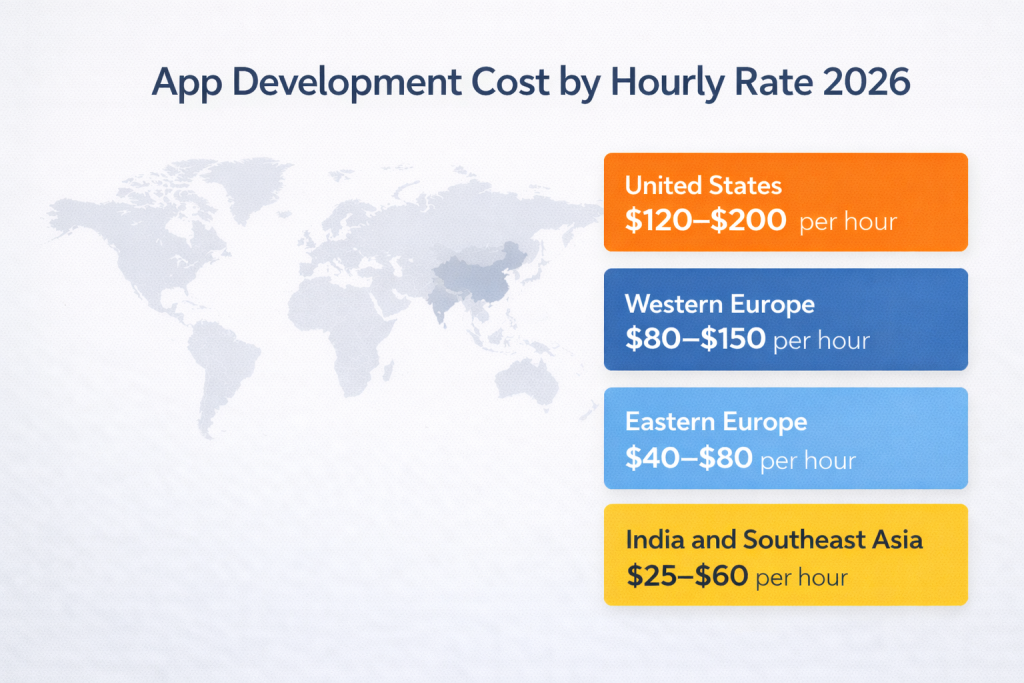
Location changes the final invoice, but it is only one variable. In 2026, typical hourly ranges look like this:
- United States: $120–$200 per hour
- Western Europe: $80–$150 per hour
- Eastern Europe: $40–$80 per hour
- India and Southeast Asia: $25–$60 per hour
Take a 1,200-hour project as a simple comparison. With a $150 hourly rate in the US, the total reaches $180,000. Eastern Europe at around $60 per hour brings the same scope closer to $72,000. In India, where rates often average $40 per hour, the budget drops to roughly $48,000.
Those numbers look straightforward. Reality is less clean. Communication overhead, seniority mix, QA maturity, and project management discipline affect delivery quality. A lower hourly rate can lead to additional revision cycles if architecture is weak or documentation is thin.
Rework is expensive. Fixing poorly structured code can consume hundreds of hours. In that scenario, a cheap start becomes a costly correction.
This is why the app development cost cannot be reduced to a single hourly number. It reflects platform decisions, backend architecture, integrations, and team structure working together.
App Development Cost by App Type in 2026
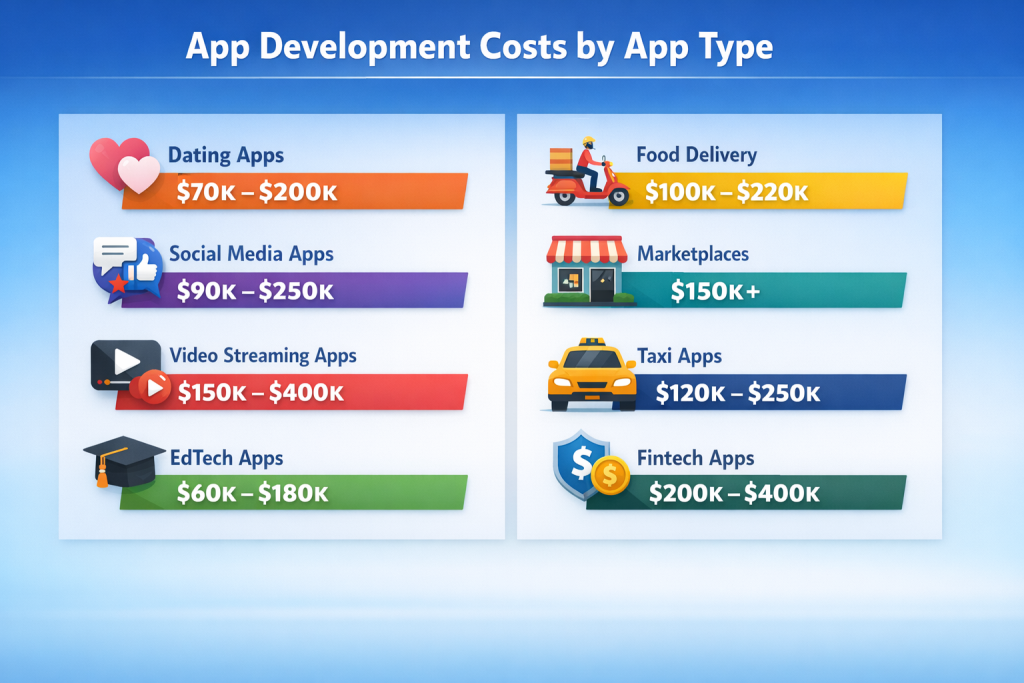
Complexity tiers tell part of the story. Category matters just as much. A dating app and a fintech wallet may both have “login + dashboard,” yet the engineering burden is completely different. The app development cost shifts depending on user roles, compliance rules, and infrastructure needs.
Below is how pricing typically plays out in 2026 across major app categories.
Consumer & Content Platforms
- Dating apps. Entry MVPs with profiles, swipe logic, and basic chat usually fall in the $70,000–$120,000 range. Add real-time messaging, photo moderation, reporting systems, and fraud detection, and budgets move toward $140,000–$200,000. Scale versions introduce recommendation algorithms, geo-matching, AI moderation, and performance tuning, pushing costs beyond $200,000.
- Social media apps. An entry MVP with profiles, feed logic, likes, comments, and basic media upload usually lands in the $90,000–$150,000 range. Once you add real-time notifications, direct messaging, story formats, content moderation pipelines, and recommendation algorithms, budgets shift toward $160,000–$250,000.
- Video streaming or VOD apps. Infrastructure defines the price here. Entry builds with video playback and user accounts may begin around $150,000. Growth versions with CDN integration, adaptive bitrate streaming, and moderation tools typically sit between $220,000 and $300,000. Live streaming with low latency, encoding pipelines, and DRM protection can move the budget toward $300,000–$400,000.
- Learning and EdTech apps. Content delivery and quizzes are manageable at $60,000–$100,000 for MVP scope. Add subscriptions, certificates, gamification, and live sessions, and the number climbs to $120,000–$180,000.
Transactional & Infrastructure-Heavy Apps
- Food delivery apps. Even basic builds require three user roles: customer, courier, restaurant. Entry builds start around $100,000 due to dispatch logic and live tracking. Growth versions with optimized routing and analytics reach $160,000–$220,000.
- Marketplace apps. Listings, search, roles, escrow payments, and admin dashboards usually start at $150,000. Dispute resolution systems and advanced filtering increase engineering time.
- Ride-hailing and taxi apps. Real-time tracking, map integrations, driver matching, and route logic place most builds between $120,000 and $250,000.
- Fintech apps. Security audits, encryption layers, transaction monitoring, and banking APIs push typical builds into the $200,000–$400,000 range quickly.
Why Infrastructure and Compliance Shift Budgets Fast
Streaming and fintech consistently land at the higher end because of infrastructure demands and regulatory oversight. Encryption standards, transaction monitoring, data storage requirements, and uptime guarantees all increase backend hours and testing cycles. Small feature lists in these industries often hide heavy engineering underneath.
Now that category differences are clear, it makes sense to look at how platform strategy further changes the budget.
iOS vs Android vs Cross-Platform in 2026
Platform choice hits the budget immediately, and the gap is visible in real quotes from 2026.
A straightforward native iOS build with login, user flows, API integration, and payment logic usually lands between $45,000 and $110,000. Add custom animations, subscription management, and deeper backend logic, and that number moves closer to $130,000–$160,000. Teams charge more when performance polish and App Store compliance require extra QA cycles.
A comparable native Android app often falls in the $50,000 to $120,000 range. Android can demand more testing time because of device variety. Different screen sizes, chipsets, and OS versions mean additional QA hours. That extra testing shows up in the invoice.
Now consider launching both platforms at the same time. You are funding two mobile engineering tracks, two testing cycles, and two store submission processes. In practice, building iOS and Android natively in parallel pushes the app development cost up by roughly 60 to 80 percent compared to starting with one platform and expanding later.
Cross-platform frameworks shift that equation. Flutter and React Native allow shared logic across both systems. For many MVPs, a dual-platform product can be delivered in the $70,000 to $150,000 range, depending on backend complexity. It works well when the interface is not hardware-heavy.
The decision is rarely about preference. It is about launch speed, testing load, and how much performance headroom the product truly needs.
Real-World Cost Examples

Abstract ranges are useful. Concrete builds are clearer. Here is how the app development cost looks in three realistic 2026 scenarios.
Case 1: Startup MVP
Scope: 5 core screens, user authentication, basic backend, Stripe payments.
Estimated budget: $45,000–$65,000.
Rough breakdown:
- Project management: 80–120 hours
- UX/UI design: 120–160 hours
- Backend engineering: 250–350 hours
- Mobile development: 300–400 hours
- QA testing: 120–180 hours
This kind of build usually fits into 3–4 months with a small focused team.
Case 2: Marketplace Platform
Scope: multi-role accounts, real-time chat, escrow payments, admin dashboard.
Estimated budget: $150,000–$220,000.
Rough hours:
- PM: 150–200
- Design: 200–300
- Backend: 600–900
- Mobile: 700–1,000
- QA: 300–400
Backend complexity drives most of the increase here.
Case 3: AI-Driven Application
Scope: external model integration, recommendation engine, data pipeline, monitoring.
Estimated budget: $250,000–$400,000+.
Rough hours:
- PM: 200+
- Design: 250–350
- Backend: 1,000–1,500
- Mobile: 800–1,200
- QA and testing: 400–600
AI adds infrastructure, logging, rate limiting, and cost tracking layers that expand engineering time fast.
Hidden Costs Most People Ignore
Launch day is not the finish line. It is the beginning of ongoing expenses that quietly reshape the app development cost over time. Many budgets cover the build but forget the lifecycle.
Maintenance and Post-Launch Support
Most professional teams estimate 15 to 25 percent of the initial build cost per year for maintenance. That includes operating system updates, security patches, dependency upgrades, and minor feature improvements. Apple and Google release major OS updates annually. Each update can break UI components or background services, forcing engineering hours that were never in the original estimate.
Infrastructure and Scaling
Hosting is rarely flat. Cloud servers, CDN bandwidth, database storage, and monitoring tools scale with user activity. A small app might run on $300 to $800 per month. After traction, infrastructure bills can move into several thousand per month. DevOps support becomes necessary to manage performance, backups, and uptime guarantees.
Compliance and Security
Apps handling payments or personal data face regulatory standards. GDPR requires data handling transparency. PCI DSS governs payment security. Healthcare apps face HIPAA obligations. Compliance often means audits, legal review, and penetration testing, each costing thousands of dollars.
App Store and Payment Fees
The Apple Developer Program costs $99 per year. Both Apple and Google charge 15 to 30 percent on in-app transactions. Payment processors add 2.5 to 3.5 percent plus transaction fees.
These expenses accumulate quietly.
So how do you keep budget under control?
How to Reduce App Development Cost Without Destroying Quality

Reducing the app development cost does not mean cutting corners. It means structuring decisions so you do not pay twice for the same mistake. Most budget overruns happen because scope expands without control or architecture is rushed.
Here are practical ways teams keep budgets realistic:
- Start with a strict MVP definition. Lock the feature list before development begins. If a feature does not directly support your core value, it waits. Every extra screen adds backend logic, testing time, and UI revisions.
- Design modular architecture from day one. Build systems in blocks so features can be added later without rewriting the foundation. A well-structured backend saves months when scaling.
- Reuse proven patterns instead of reinventing flows. Authentication, subscription handling, notification logic, and admin dashboards follow common structures. Customizing only where it matters keeps engineering hours focused.
- Invest in a strong discovery phase. Clear documentation, wireframes, and technical planning reduce mid-project changes. Rework is one of the fastest ways to inflate budgets.
- Control feature creep. It is easy to add “one more idea” during development. Each change triggers redesign, retesting, and sometimes architectural shifts.
Smart planning lowers risk. Cutting strategy raises it.
In-House vs Agency vs Custom Development Partner
The app development cost changes dramatically depending on how you build the team.
An in-house setup sounds attractive until you calculate the real payroll. In 2026, a senior mobile developer in the US often earns $120,000 to $160,000 per year. A backend engineer sits in a similar range. Add a designer at $90,000+, a QA engineer at $70,000+, and a project manager, and annual payroll easily crosses $400,000 before benefits, taxes, and recruiting fees. Hiring alone can take months. During that time, you are paying without shipping.
Agencies solve the hiring problem, but they build margin into their rates. You gain speed and structured delivery, yet hourly pricing often includes overhead for sales, operations, and account management. Agencies are efficient for defined scopes, but long-term flexibility may cost more.
A dedicated development partner model sits between those extremes. You work with an assigned engineering team that focuses on your product without full in-house payroll burden. Budget forecasting becomes clearer because the scope and delivery milestones are defined upfront. You retain strategic control without building HR infrastructure.
This model is where companies like Scrile operate, offering structured development without forcing you to assemble the entire machine yourself.
Scrile Custom Development Services: Structured Cost, Controlled Scope
When projects run over budget, it is rarely because someone wrote too much code. It happens when scope is unclear, architecture is rushed, or integration details surface too late. Managing app development cost requires structure from the first planning session.
Scrile approaches development as a staged process rather than a quick build. The goal is predictable delivery, not vague estimates that shift halfway through.
From Discovery to Scalable Release
Scrile’s workflow begins with a discovery phase. That includes business analysis, requirement clarification, user flow mapping, and technical planning. Instead of guessing timelines, the team defines architecture and milestones before development starts. That early structure directly stabilizes the app development cost because it reduces mid-project changes.
After discovery, the focus moves into execution:
- UX and UI design that aligns product goals with user behavior, not generic templates.
- Dedicated engineering teams covering backend, mobile, and frontend development.
- Scalable cloud architecture, including infrastructure planning, database strategy, and DevOps support.
- Integration-ready builds, prepared for payment systems, third-party APIs, analytics, and compliance layers.
- Quality assurance and testing, structured across platforms and environments.
- Post-launch maintenance and support, including updates, scaling, and infrastructure monitoring.
Scrile’s services extend beyond initial deployment. Hosting support, cloud optimization, and long-term product iteration are built into the engagement model. That continuity prevents the common problem where a product launches and then struggles without technical oversight.
The objective is not to sell a package. It is to define scope accurately, align technical architecture with business logic, and ensure that your budget matches the complexity of what you are building.
Conclusion
When someone hears a number like $100,000 or $300,000, the first reaction is usually shock. It feels like a lot for “an app.” But the invoice is not about screens. It is about the system behind those screens.
You are paying for backend architecture that can support thousands of users without slowing down or breaking under load. Secure authentication, encrypted payment flows, and carefully structured databases all require engineering time. Thorough testing reduces the risk of crashes once real users arrive. The technical decisions made during development shape what scaling will cost later, whether that means a small upgrade or a major rebuild.
Architecture is invisible when it works. It becomes obvious when it fails. The same applies to security. Cutting corners may save money in the first release cycle. Fixing weak foundations later often costs more than building them correctly at the start.
That is why budget planning should be treated as a strategic move, not a guessing game. The number reflects complexity, traffic expectations, integrations, and long-term product goals.
If you want clarity before committing resources, the practical step is to speak directly with engineers who can evaluate scope and infrastructure requirements. Contact the Scrile team to estimate your project and align technical planning with your business goals.

Polina Yan is a Technical Writer and Product Marketing Manager, specializing in helping creators launch personalized content monetization platforms. With over five years of experience writing and promoting content, Polina covers topics such as content monetization, social media strategies, digital marketing, and online business in adult industry. Her work empowers online entrepreneurs and creators to navigate the digital world with confidence and achieve their goals.