

Anyone searching for telemedicine app development cost quickly notices one thing: there is no single number. Estimates range widely, and that’s not because agencies can’t agree. It’s because “telemedicine app” describes very different products. A basic video consultation tool and a full-scale healthcare platform may share a label, yet their budgets live in different worlds.
You’ll often see figures like $40,000–$200,000+, and that range exists for a reason. At the lower end are focused MVPs with limited roles, standard video calls, and simple scheduling. At the higher end are systems built for clinics, networks of providers, or regulated markets, where compliance, integrations, and reliability drive complexity. Features add cost, but architecture and responsibility add more.
Another reason prices fluctuate is decision-making early in the process. Platform choice, security model, and how data is handled all affect scope. So does geography, team composition, and whether the product is meant to scale beyond its first release.
This article is written for founders, product managers, and healthcare teams who want clarity. We’ll break down real cost tiers used in 2026, explain what pushes budgets up or down, and show where money is usually underestimated. The goal is not to sell a dream, but to help you plan a telemedicine product with realistic expectations and fewer surprises.
What Telemedicine App Actually Means in 2026

Ask ten teams what a telemedicine app is, and you’ll get ten different answers. That’s one reason telemedicine app development cost is so hard to pin down. The label sounds narrow, but the products behind it vary a lot in scope, responsibility, and risk.
Some projects are built around a very direct use case. A patient books a slot, joins a video call, and leaves. Others look more like full healthcare systems, with layers of roles, permissions, and long-term data. The gap between those two ideas has little to do with video technology and everything to do with how the product is used.
Common Telemedicine App Scenarios That Shape Cost
Most telemedicine apps in 2026 fall into a few recognizable scenarios:
- One-to-one doctor consultations
These apps are usually the simplest to launch. A limited number of user roles, clear session boundaries, and straightforward scheduling keep development focused. Costs stay lower because workflows are predictable. - Clinics and multi-provider platforms
As soon as multiple doctors are involved, things change. Calendars overlap. Patients move between providers. Admin panels become necessary. Even without advanced medical integrations, coordination alone adds weeks of work. - Mental health and coaching use cases
These products rely on continuity. Sessions repeat, relationships build, and context matters. Features like private messaging, session history, reminders, and subscriptions often become core, not optional. - Corporate or insurance-backed telehealth
This is where scale and accountability dominate. Access rules are strict, reporting is expected, and downtime is not tolerated. Even small changes need careful review, which affects both timelines and budgets.
What pushes costs up here isn’t cutting-edge tech. Video calls, chat, and notifications are well understood. The real driver is scope. How many people interact? How often? What happens when access changes or data needs to be reviewed?
Compliance plays a quiet role in all of this. Even apps that avoid heavy regulation still need secure storage, encrypted communication, and clear data boundaries. Treating those as afterthoughts almost always leads to revisions later.
In short, the meaning of “telemedicine app” has widened. Defining your version early is the most practical way to control cost.
Key Factors That Shape Telemedicine App Development Cost

When teams ask why telemedicine app development cost varies so widely, the answer usually sits in three areas: what the product does, how it is built, and what responsibilities it carries. These factors interact with each other. Adding one feature often affects architecture, security, and long-term maintenance. That is why budgets grow in layers rather than in neat increments.
Before breaking this down further, it helps to remember one thing. Technology itself is rarely the biggest expense. Decisions about scope, reliability, and compliance are what shape the final number.
Feature Depth and Product Scope
Features are the most visible cost driver, but not in the way many people expect. Video consultations, chat, and file sharing are now well understood. The cost comes from how tightly these features are connected to user workflows and data.
A simple app that offers video calls with basic chat is one thing. Add scheduling logic, automated reminders, and payment handling, and the system starts coordinating time, money, and access. Medical records raise the bar again. Even lightweight records require structured storage, permissions, and clear separation between users.
Feature scope usually expands across several layers:
- Real-time communication such as video, chat, and document sharing
- Operational logic like scheduling, cancellations, reminders, and payments
- Data-heavy components including visit history, notes, and integrations with external systems
Each layer increases the telemedicine app development cost because it adds edge cases. What happens when a payment fails. When a session is rescheduled. When access changes. These scenarios demand careful logic, testing, and ongoing support.
Platform and Architecture Choices
The second major driver is how the app is built and where it lives. A browser-based telemedicine app can be faster to launch and easier to maintain. Native mobile apps often feel smoother for users but require more work across platforms.
Architecture choices also affect future costs. Cross-platform frameworks reduce initial development time, but they may introduce performance limits or dependency risks later. Native builds cost more upfront but offer greater control over device-level features and optimization.
Hosting decisions play a quiet but important role. Telemedicine apps deal with live video traffic, personal data, and unpredictable usage spikes. Building for ten concurrent sessions is different from building for hundreds. Scalability planning often adds backend complexity early, which raises the initial telemedicine app development cost but prevents expensive rewrites later.
Compliance, Security, and Data Handling
Compliance is where many budgets stretch unexpectedly. Regulations like HIPAA and GDPR do not come with fixed price tags. They influence architecture, development processes, and even design decisions.
Security requirements touch nearly every part of the system. Encryption is needed for data in transit and at rest. Storage must be controlled and auditable. Access logs need to exist and be reliable. None of this is optional once personal health information is involved.
What makes compliance expensive is not paperwork. It is the way it multiplies effort:
- More time spent designing data flows and access rules
- Additional testing and validation cycles
- Restrictions on third-party services and shortcuts
Instead of adding a single line item to the budget, compliance reshapes the entire build. This is why two apps with similar features can have very different costs. One may be designed for casual coaching. The other must stand up to regulatory scrutiny.
In the end, telemedicine app development cost reflects responsibility as much as functionality. The more a product promises to handle safely and reliably, the more effort is required to build it right.
Average Telemedicine App Development Cost in 2026
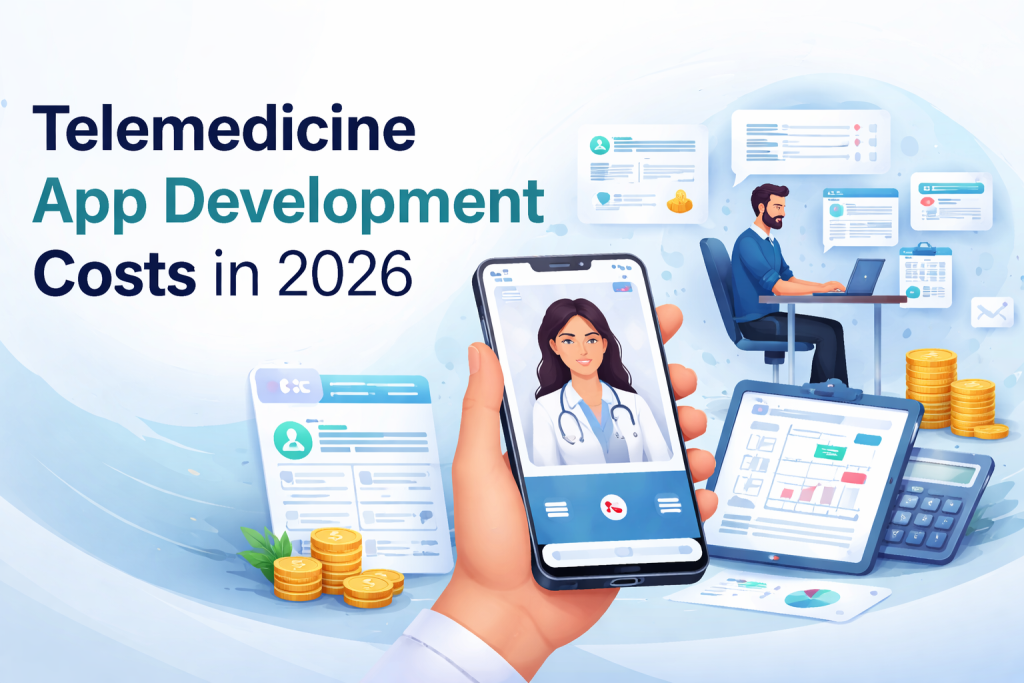
In 2026, the telemedicine app development cost is best understood in tiers rather than a single average. Most credible estimates cluster projects by scope, responsibility, and timeline. This approach reflects reality far better than a flat number, because the difference between a pilot product and a regulated healthcare system is measured in months and hundreds of development hours.
At a high level, current market data shows that telemedicine projects usually fall into three cost brackets. Each bracket is tied not only to features, but also to delivery speed, compliance depth, and how many people rely on the system daily.
Typical Cost Tiers and What They Include
At a high level, current market data shows that telemedicine projects usually fall into three cost brackets. Each bracket is tied not only to features, but also to delivery speed, compliance depth, and how many people rely on the system daily:
- MVP-level telemedicine apps: $30,000–$60,000. These projects are built to validate an idea quickly. They usually include basic video consultations, simple scheduling, user authentication, and limited payments. Development timelines often sit around 3 to 4 months with a small team. Compliance considerations are minimal, often limited to secure communication and basic data storage. These apps work well for pilots, early-stage startups, or internal testing, but they are not designed to scale without refactoring.
- Mid-range custom solutions: $70,000–$150,000. This is the most common range for commercial telemedicine products in 2026. Apps at this level support multiple providers, role-based access, richer scheduling logic, notifications, and more polished user interfaces. Development usually takes 5 to 7 months. Security and data handling are treated seriously, with encryption, audit trails, and structured storage. This tier often represents the real-world cost of telemedicine app development for clinics, mental health platforms, and paid consultation services.
- Complex or enterprise-grade platforms: $180,000–$300,000+. These systems are built for scale and accountability. They may include multi-location clinics, advanced reporting, integrations with EHR or billing systems, and strict compliance requirements. Development timelines stretch to 9–12 months or more, often involving backend-heavy work and extended testing cycles. Budgets rise not because of flashy features, but because reliability, uptime, and data integrity become critical.
How Timelines Influence Cost
Time and cost move together, but not linearly. A 3-month build might involve 2–3 developers working in parallel. A 9-month build often involves backend specialists, mobile developers, QA engineers, and compliance reviews running simultaneously. Longer timelines also mean more iterations, feedback loops, and refinement.
Concrete examples make this clearer. A mental health app offering weekly video sessions, subscriptions, and therapist dashboards rarely stays under $80,000. A corporate telehealth portal with reporting, admin control, and secure data segregation can exceed $200,000 before launch.
In 2026, realistic budgeting means choosing the tier that matches responsibility, not ambition. The more users trust the app with their health and data, the higher the investment required to build it properly.
Where Budgets Often Go Wrong
Most teams don’t blow their budget because they chose the wrong framework or paid too much per hour. The real damage usually happens earlier, when assumptions quietly replace decisions. By the time the problem is visible, the money is already spent.
One of the most common mistakes is treating compliance and security as a box to tick later. Teams assume they can “add HIPAA” or tighten data handling after launch. In practice, security decisions shape architecture from day one. When encryption models, access rules, or audit logs are bolted on late, core parts of the system have to be rebuilt. That rework is expensive, slow, and frustrating.
Another pattern shows up once stakeholders get involved. Features multiply. A calendar becomes three calendars. Chat needs file uploads. Video needs session recording “just in case.” None of these requests sound unreasonable on their own. Together, they stretch timelines and inflate the telemedicine app development cost far beyond the original estimate. The issue isn’t ambition. It’s lack of prioritization.
Early architectural shortcuts cause quieter problems. Some teams choose a stack that works for demos but struggles under real load. Others underestimate how live video traffic affects backend performance. These choices don’t always fail immediately. They fail when users arrive, which is the worst possible moment to rethink foundations.
Post-launch costs are also easy to ignore. Telemedicine apps don’t freeze after release. They need updates, monitoring, server scaling, and support. Video infrastructure changes. Regulations evolve. Devices update. If maintenance isn’t planned, budgets appear “blown” even though the work is normal and necessary.
Budgets go wrong when decisions are delayed. Clear scope, realistic responsibility, and early technical discipline do more to control cost than any spreadsheet ever will.
Ready-Made Solutions vs Custom Telemedicine Apps

At some point, most teams face the same decision: use a ready-made telemedicine solution or invest in a custom build. On paper, the choice looks obvious. Templates promise speed and lower entry cost. Custom development looks slower and more expensive. In practice, the trade-off is more nuanced, and it has a direct impact on telemedicine app development cost over time.
Below is a practical comparison that reflects how these options behave beyond the launch phase.
| Criteria | Ready-made solution | Custom telemedicine app |
| Initial cost | Lower upfront, often subscription-based | Higher upfront investment |
| Time to launch | Very fast (weeks) | Moderate to long (months) |
| Customization level | Limited to platform settings | Fully tailored to product logic |
| Compliance flexibility | Fixed by vendor | Designed around target markets |
| Long-term scalability | Restricted by platform limits | Scales with business needs |
| Ownership and branding | Vendor-controlled | Full ownership and branding |
Choosing Between Speed and Control
The appeal of ready-made tools is easy to understand. They are quick to deploy and require minimal technical effort. For pilots, internal testing, or very small teams, they can be a reasonable starting point. When requirements are simple and unlikely to change, these tools reduce time to market and avoid early engineering risk.
The problem appears later. As usage grows, businesses often discover that workflows don’t quite fit. Access rules are rigid. Integrations are unavailable. Pricing logic can’t be adjusted. Compliance requirements are dictated by the vendor rather than the market you operate in. At that stage, teams start paying not just for the tool, but for workarounds.
This is why “cheaper upfront” often becomes more expensive in the long run. Migration costs, lost flexibility, and technical limits quietly add to the telemedicine app development cost without improving the product.
Custom telemedicine apps make sense when the application is part of the business itself, not just a supporting tool. They become essential when branding, ownership, data control, and scalability matter. In those cases, the higher initial investment buys freedom instead of constraints.
How to Avoid Cost Overruns Without Cutting Quality
Most cost overruns don’t come from bad luck. They come from vague planning and delayed decisions. The first safeguard is a smart MVP definition. An MVP is not a smaller version of the final product. It’s a version that proves the core workflow works. Video, scheduling, and secure access are usually enough. Everything else can wait.
Feature prioritization matters more than people expect. Stakeholders often push for “nice to have” additions early because they feel cheap at the idea stage. They aren’t cheap once design, testing, and compliance are involved. Locking priorities early keeps the telemedicine app development cost predictable instead of reactive.
Iterative development also reduces risk. Big-bang builds look efficient on paper, but they hide problems until late. Smaller releases expose gaps earlier, when fixes are still affordable. This approach protects quality because feedback arrives before the system hardens.
Choosing the right partner is where many teams miscalculate. Regional development rates do matter, but not in isolation. Hourly ranges roughly look like this: North America ($100–$250), Western Europe ($50–$150), Eastern Europe ($30–$100), Asia ($20–$50). Lower rates reduce line items, but coordination, compliance experience, and healthcare familiarity often compress those savings. A cheaper team that needs constant correction quickly stops being cheap.
The most effective cost control strategies usually include:
- Clear MVP boundaries tied to real user journeys, not feature wishlists
- Prioritized roadmaps that separate launch needs from future improvements
- Incremental delivery with early validation and adjustment
- A development partner experienced in healthcare constraints, not just general apps
Cost discipline isn’t about cutting corners. It’s about making fewer assumptions and fewer late changes.
Calculate the Budget for Your Custom Telemedicine App with Scrile Meet
When teams ask for a telemedicine budget, the real challenge is not the number itself. It’s understanding what that number includes. Scrile Meet approaches this differently because it is not a platform and not a ready-made product. It is a custom development service built around your specific use case, market, and regulatory needs.
Instead of starting with a template, Scrile Meet starts with clarification. What exactly will users do in the app. Who accesses what. Which actions trigger payments, sessions, or data storage. This upfront work shapes a realistic telemedicine app development cost rather than an optimistic estimate that collapses later.
How Scrile Meet Builds Cost Clarity
Scrile Meet structures estimation around a few concrete steps:
- Feature mapping
Every feature is mapped to a user flow. Video consultations, chat, scheduling, and payments are defined as behaviors, not checkboxes. This avoids paying for features that look good but add no real value. - Compliance planning
Security and data handling are planned early. Instead of adding compliance later, Scrile Meet designs storage, access rules, and communication layers with regulation in mind from the start. - Phased development
Projects are split into phases with clear outputs. This allows teams to launch faster, validate assumptions, and expand without rewriting the core system.
What Scrile Meet enables goes beyond basic functionality:
- Video consultations with stable real-time communication
- Scheduling systems tied directly to provider availability
- Secure messaging and file exchange
- Payment flows that match your business logic
- Full branding, data ownership, and control
This approach reduces surprises because cost drivers are visible early. Changes don’t cascade unpredictably. When scope evolves, the impact on timeline and budget is clear before work begins.
Scrile Meet fits clinics, independent practitioners, mental health services, coaching platforms, and enterprise telehealth initiatives. In each case, the goal stays the same — build only what the product truly needs, and build it in a way that can grow.
If you need a realistic budget instead of a guess, Scrile Meet calculates it from the inside out. That discipline is what keeps quality high and costs under control.
Conclusion
When people talk about telemedicine app development cost, it’s tempting to focus on the headline number. In reality, that number represents a set of decisions. Reliability, compliance, and scalability all have a price, and they show up whether you plan for them or not. The difference is control. Planned investment feels expensive upfront. Unplanned fixes cost more later.
A telemedicine app is not just a video call with a calendar attached. It carries responsibility. Patients trust it with personal information. Providers rely on it to show up on time and work consistently. As usage grows, the system has to keep up without cutting corners. That’s why cost depends far more on intent than on templates. Two apps can look similar to users and still differ massively in what it takes to build and maintain them.
Choosing features carefully, designing for compliance early, and thinking about scale from day one all shape the final budget. Skipping those steps doesn’t remove their cost. It only delays it. In that sense, development spend is less about buying software and more about building confidence into the product.
If you’re planning a telemedicine product and want clarity instead of guesswork, it makes sense to explore options built around your actual requirements. Explore Scrile Meet solutions to see how a custom approach can turn cost planning into a structured, transparent process rather than a series of surprises.

Polina Yan is a Technical Writer and Product Marketing Manager, specializing in helping creators launch personalized content monetization platforms. With over five years of experience writing and promoting content, Polina covers topics such as content monetization, social media strategies, digital marketing, and online business in adult industry. Her work empowers online entrepreneurs and creators to navigate the digital world with confidence and achieve their goals.